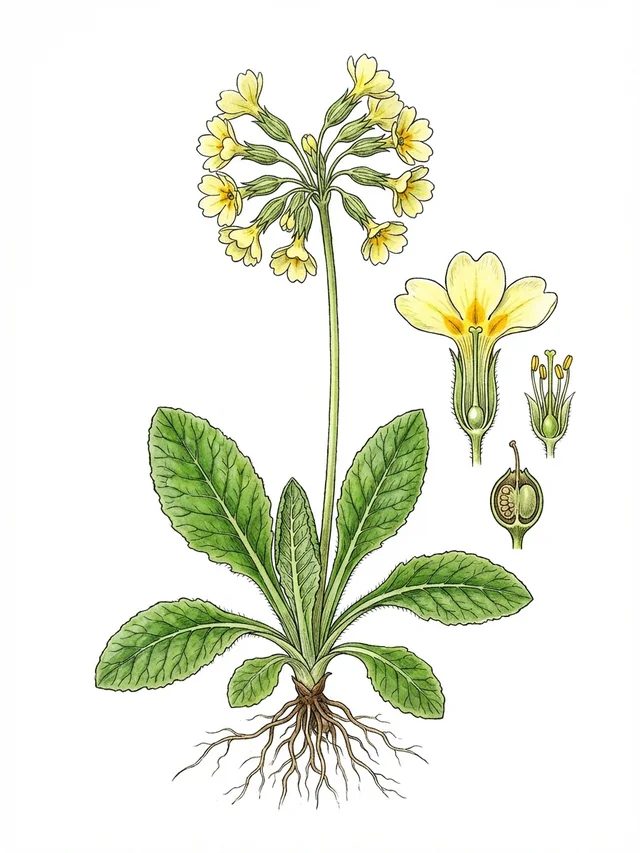
 Bild folgtKI-generierte Illustration
Setaria pumila
Setaria pumila
FamilyGenus: Setariaheimisch in Deutschland
🌿
5
Species
interact
🔗
5
Interactions
documented
About this species
An introduced grass that has become established in Great Britain, Setaria pumila is a broad-leaved species favouring sunny, moderately moist, fertile soils. Its flowering period extends from July to October.
Ecological network
Click to highlight connections · Click again to open species page
Netzwerk wird geladen...
Flower visit
Ecological significance
Setaria pumila is an established introduction in Great Britain, having arrived historically as a seed contaminant. It can appear in low-disturbance, sunny sites with fertile soils, such as field margins or waste ground.
Annual cycle
Flowering occurs between July and October, with seed production following shortly after.
Standort & Merkmale
Light
Sonne
Moisture
Frisch (Mäßig feucht)
Soil
Mittelzehrer (Normaler Boden)
Bloom time
Jul – Okt
Soil reaction
Mäßig sauer bis neutral
Bioregion
Continental
Growth form
Gras
Woodiness
Nicht verholzt
Leaf type
Breitblättrig
Plant height
0.448 m
Morphological traits: TRY ID3 (CC BY 3.0) & TRY ID81 (CC BY)
Pflege & Anbau
This grass thrives in full sun and fresh, moderately fertile soil. It requires little disturbance and is not suited to saline conditions.
Scientific profile
Setaria pumila is a terrestrial, non-woody grass with broad leaves, typically reaching a height of around 0.45 metres. Leaf area averages approximately 1890 mm². It flowers from July to October. Ecologically, it shows a strong preference for full sun and moderately moist, fertile soils, and is associated with sites of low disturbance; it does not tolerate salinity. The species originates from parts of Europe, temperate Asia, the Middle East, Africa and Northeast Tropical Africa. In Great Britain it is an introduced plant that has become established, very likely arriving as a seed contaminant. The diaspores (seeds) are small, with a mass of about 1.58 mg.
Other flower visitors
5 other species visit the flowers
Sources & data origin
•TraitCH — CC BY 4.0TraitCH 2.0 contributors; imported as source-preserving NaturKompass taxon evidence.
•Interaktionsdaten via GloBI (CC-BY 4.0)
•FloraWeb / BfN
•EIVE 1.0 — Dengler et al. (2023), DOI: 10.3897/VCS.98324 (CC BY 4.0)
•GBIF Backbone Taxonomy — GBIF Secretariat (2024), DOI: 10.15468/39omei (CC BY 4.0)
•TRY Categorical Traits (ID3) — Kattge et al. (2012), DOI: 10.17871/TRY.3 (CC BY 3.0)
•TRY Global Spectrum (ID81) — Díaz et al. (2016/2021), DOI: 10.17871/TRY.81 (CC BY)
•Checklist Alien Plants Belgium — Verloove F (2023), Botanic Garden Meise (CC BY 4.0)
•Govaerts R et al. (2025) — World Checklist of Vascular Plants (WCVP) v14. Royal Botanic Gardens, Kew. DOI: 10.34885/xs7h-ze42 (CC BY 4.0)
All data is licensed under CC BY 4.0, CC0, or compatible. Attribution according to license terms. Full source overview →