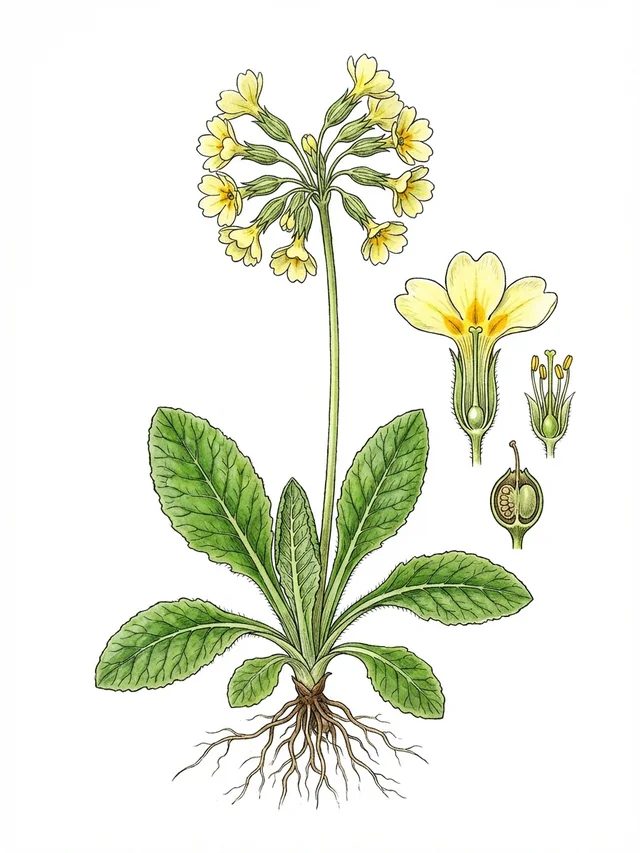
 Bild folgtKI-generierte Illustration
Trinia glauca
Trinia glauca
FamilyGenus: Triniaheimisch in Deutschland
🌿
7
Species
interact
🔗
16
Interactions
documented
About this species
A low-growing native herb of dry, infertile calcareous soils, bearing umbels of small flowers in late spring.
Ecological network
Click to highlight connections · Click again to open species page
Netzwerk wird geladen...
PollinationFlower visit
Ecological significance
As a native wildflower, it supplies nectar and pollen to flower-visiting insects.
Annual cycle
Flowering periodMay to June.
Standort & Merkmale
Light
Sonne
Moisture
Trocken
Soil
Schwachzehrer (Magerer Boden)
Bloom time
Mai – Jun
Soil reaction
Basisch / Kalkhold
Bioregion
Continental
Nectar value
2
Pollen value
2
Growth form
Krautige Pflanze
Woodiness
Nicht verholzt
Leaf type
Breitblättrig
Plant height
0.214 m
Morphological traits: TRY ID3 (CC BY 3.0) & TRY ID81 (CC BY)
Pflege & Anbau
Plant in full sun in a very well-drained, nutrient-poor, calcareous soil. Tolerates dry conditions and is suitable for rock gardens or gravel beds. Avoid rich or moisture-retentive ground.
Scientific profile
Trinia glauca is a low-growing, non-woody herbaceous plant in the Apiaceae that is native in Great Britain. It typically reaches about 21 cm in height and bears broad leaves. It thrives in full sun on dry, very nutrient-poor, calcareous soils and shows a preference for sites with little disturbance. Flowering occurs in May and June, producing small umbels that offer both nectar and pollen. The seeds (diaspores) are minute, weighing around 1.7 mg each. The plant forms arbuscular mycorrhizal associations.
Bestäuber & Besucher
2 Arten interagieren mit dieser Pflanze
Pipizella zeneggenensisPipizella virens
Other flower visitors
5 other species visit the flowers
Formica fuscaLasius alienusMyrmecoris gracilisPhyllobius roboretanusTemnothorax albipennis
Sources & data origin
•TraitCH — CC BY 4.0TraitCH 2.0 contributors; imported as source-preserving NaturKompass taxon evidence.
•Interaktionsdaten via GloBI (CC-BY 4.0)
•pollinator_interactions
•FloraWeb / BfN
•EIVE 1.0 — Dengler et al. (2023), DOI: 10.3897/VCS.98324 (CC BY 4.0)
•EuPPollNet — Kuppler et al. (2025), DOI: 10.1111/geb.70000 (CC BY 4.0)
•Database of Pollinator Interactions (DoPI) — Pocock et al. (2022), DOI: 10.1002/ecy.3801 (CC BY)
•GBIF Backbone Taxonomy — GBIF Secretariat (2024), DOI: 10.15468/39omei (CC BY 4.0)
•TRY Categorical Traits (ID3) — Kattge et al. (2012), DOI: 10.17871/TRY.3 (CC BY 3.0)
•TRY Global Spectrum (ID81) — Díaz et al. (2016/2021), DOI: 10.17871/TRY.81 (CC BY)
•Govaerts R et al. (2025) — World Checklist of Vascular Plants (WCVP) v14. Royal Botanic Gardens, Kew. DOI: 10.34885/xs7h-ze42 (CC BY 4.0)
All data is licensed under CC BY 4.0, CC0, or compatible. Attribution according to license terms. Full source overview →