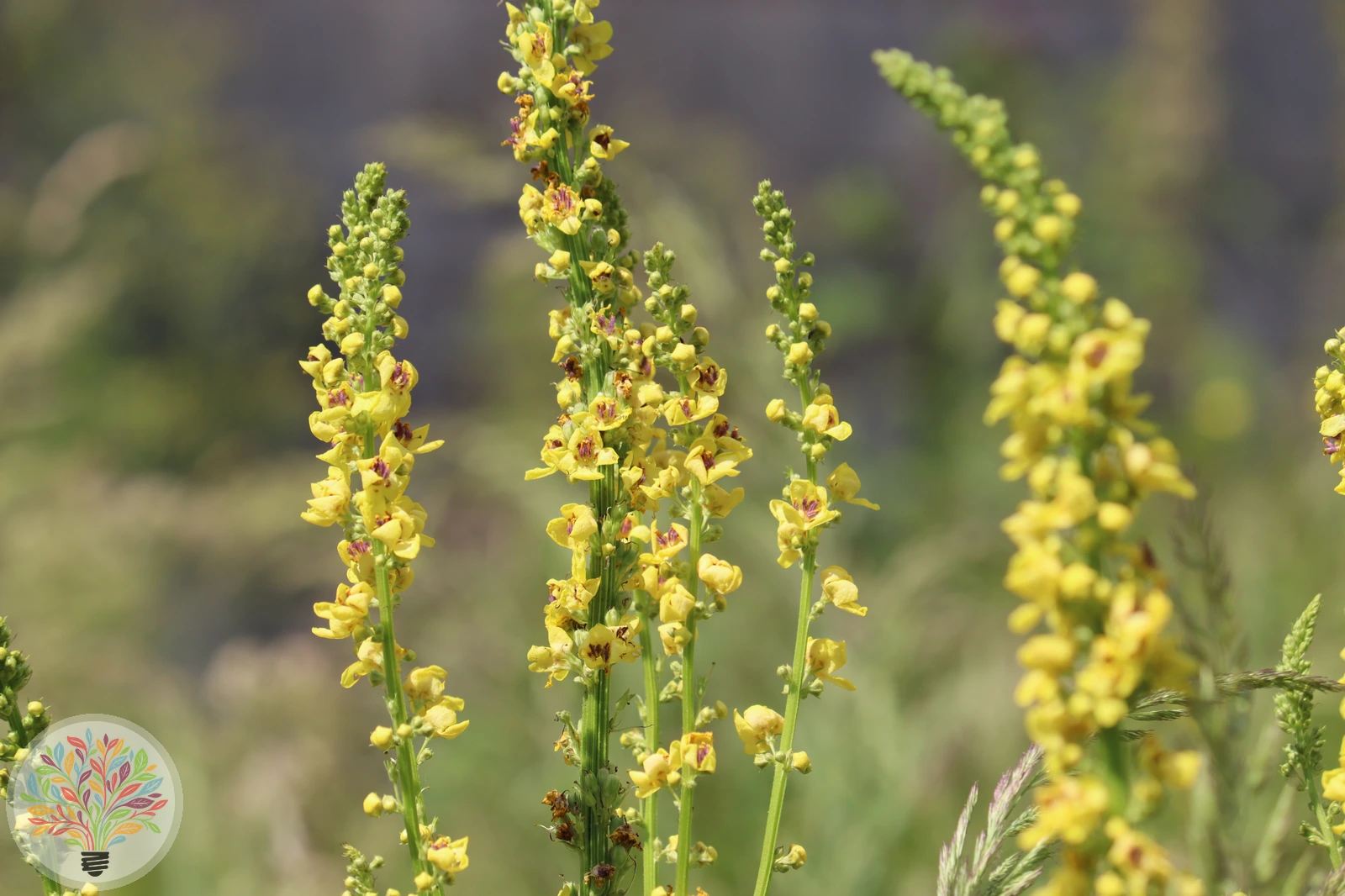
Verbascum nigrum
Verbascum nigrum
FamilyGenus: Verbascumheimisch in Deutschland
🌿
9
Species
interact
🔗
16
Interactions
documented
🐛
1
Host relationships
Species
About this species
Verbascum nigrum is a native herbaceous perennial of sunny, nutrient-rich, calcareous soils. Its spires of yellow flowers open from June to August, providing nectar and pollen for insects.
Ecological network
Click to highlight connections · Click again to open species page
Netzwerk wird geladen...
PollinationLarval host
Ecological significance
A native component of open, sunny habitats on nutrient-rich calcareous ground. Its flowers support a range of insect visitors by supplying both nectar and pollen from June to August, contributing to local pollinator networks.
Annual cycle
Flowering stems appear from June to August.
Standort & Merkmale
Light
Sonne
Moisture
Frisch (Mäßig feucht)
Soil
Starkzehrer (Nährstoffreicher/Fetter Boden)
Bloom time
Jun – Aug
Soil reaction
Basisch / Kalkhold
Bioregion
Continental
Nectar value
3
Pollen value
3
Growth form
Krautige Pflanze
Woodiness
Nicht verholzt
Leaf type
Breitblättrig
Plant height
0.813 m
Morphological traits: TRY ID3 (CC BY 3.0) & TRY ID81 (CC BY)
Pflege & Anbau
Plant in full sun in well-drained, fertile, alkaline to neutral soil. Keep the ground moderately moist, especially during dry spells. As a heavy feeder, it benefits from an annual mulch of well-rotted compost. Deadhead spent spikes to encourage additional flowering. The plant is non-woody and herbaceous, dying back above ground in autumn.
Scientific profile
A herbaceous perennial growing to around 0.8 m tall. The broad leaves form a basal rosette, from which arise flowering stems bearing spikes of yellow blooms between June and August. Each flower offers accessible nectar and pollen (rated 3 on a 0–4 resource scale), and the plant forms arbuscular mycorrhizal associations. It favours full sun and thrives on fresh, moderately moist, nutrient-rich, calcareous soils. The species is native in Great Britain and belongs to the family Scrophulariaceae.
Bestäuber & Besucher
8 Arten interagieren mit dieser Pflanze
Eristalis tenaxBombus lapidariusBombus hypnorumLasioglossum lucidulumBombus pascuorumSphaerophoria scriptaMelanostoma scalarePlatycheirus scutatus
Host relationships
1 species use this plant as a host
Eupithecia subumbrata
Sources & data origin
•Cook et al. (2025) UK Butterfly & Moth Traits (DOI: 10.5285/dbc7cc17-cbbd-49dd-bab4-8e8855768d66)
•pollinator_interactions
•FloraWeb / BfN
•EIVE 1.0 — Dengler et al. (2023), DOI: 10.3897/VCS.98324 (CC BY 4.0)
•EuPPollNet — Kuppler et al. (2025), DOI: 10.1111/geb.70000 (CC BY 4.0)
•Database of Pollinator Interactions (DoPI) — Pocock et al. (2022), DOI: 10.1002/ecy.3801 (CC BY)
•GBIF Backbone Taxonomy — GBIF Secretariat (2024), DOI: 10.15468/39omei (CC BY 4.0)
•TRY Categorical Traits (ID3) — Kattge et al. (2012), DOI: 10.17871/TRY.3 (CC BY 3.0)
•TRY Global Spectrum (ID81) — Díaz et al. (2016/2021), DOI: 10.17871/TRY.81 (CC BY)
•Govaerts R et al. (2025) — World Checklist of Vascular Plants (WCVP) v14. Royal Botanic Gardens, Kew. DOI: 10.34885/xs7h-ze42 (CC BY 4.0)
•Foto: © Adobe Stock / AdobeStock_922742011
All data is licensed under CC BY 4.0, CC0, or compatible. Attribution according to license terms. Full source overview →