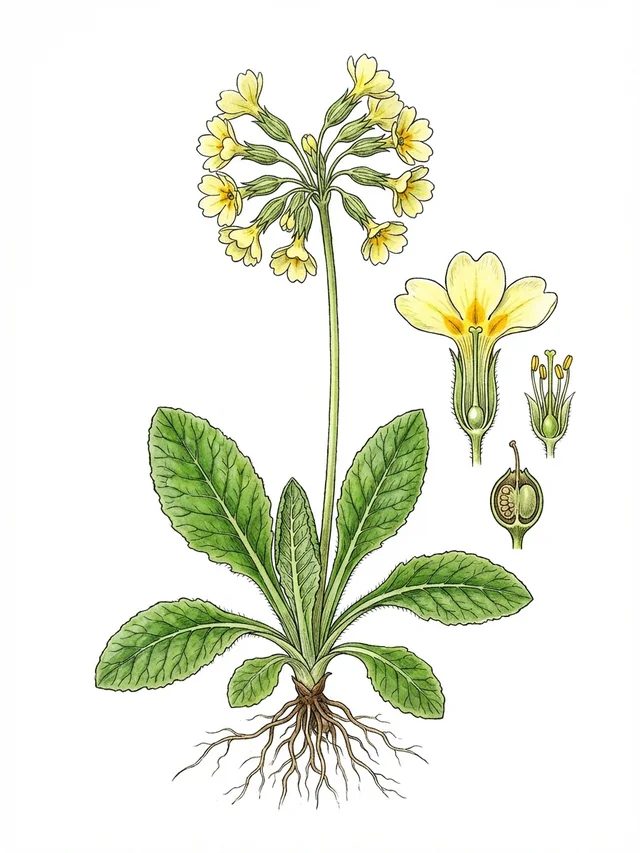
 Bild folgtKI-generierte Illustration
Veronica hederifolia
Veronica hederifolia
FamilyGenus: Veronicaheimisch in Deutschland
🌿
1
Species
interact
🔗
1
Interactions
documented
🐛
1
Host relationships
Species
About this species
Veronica hederifolia is an archaeophyte established in Britain, a low-growing herbaceous plant with broad leaves, favouring semi-shaded, moist, nutrient-rich, calcareous soils. It flowers from March to May.
Ecological network
Click to highlight connections · Click again to open species page
Netzwerk wird geladen...
Larval host
Ecological significance
No significant adverse ecological impacts are recorded in Britain.
Annual cycle
Flowering takes place from March to May.
Safety note
No specific safety concerns are documented.
Standort & Merkmale
Light
Halbschatten
Moisture
Frisch (Mäßig feucht)
Soil
Starkzehrer (Nährstoffreicher/Fetter Boden)
Bloom time
Mär – Mai
Soil reaction
Basisch / Kalkhold
Bioregion
Continental
Growth form
Krautige Pflanze
Woodiness
Nicht verholzt
Leaf type
Breitblättrig
Plant height
0.161 m
Morphological traits: TRY ID3 (CC BY 3.0) & TRY ID81 (CC BY)
Pflege & Anbau
Prefers semi-shade and fresh, moderately moist, nutrient-rich, calcareous to basic soil. Suitable for naturalistic planting in woodland edges or shaded borders. Keep the soil evenly moist but well-drained.
Scientific profile
Veronica hederifolia is a small, non-woody herbaceous plant typically reaching about 16 cm in height, with broad leaves. In Britain it is regarded as an archaeophyte, having become established during ancient times. The species grows in semi-shaded places and fresh, moderately moist, nutrient‑rich soils that are calcareous to basic. Flowering occurs from March to May. It forms arbuscular mycorrhizal associations and is fully terrestrial. The leaf area averages approximately 260 mm² and the diaspores weigh roughly 3.7 mg.
Sources & data origin
•TRY v6.0 / BiolFlor flowering phenology (Request 47350) — CC BY 4.0TRY request 47350 (Public, Data Released, TRY v6.0; 2026-02-15). Cite TRY: Kattge et al. (2020), doi:10.1111/gcb.14904; original source: Trefflich, A., Klotz, S. & Kühn, I. (2002). Blühphänologie. BIOLFLOR, Schriftenreihe für Vegetationskunde 38:127–131.
•Cook et al. (2025) UK Butterfly & Moth Traits (DOI: 10.5285/dbc7cc17-cbbd-49dd-bab4-8e8855768d66)
•FloraWeb / BfN
•EIVE 1.0 — Dengler et al. (2023), DOI: 10.3897/VCS.98324 (CC BY 4.0)
•GBIF Backbone Taxonomy — GBIF Secretariat (2024), DOI: 10.15468/39omei (CC BY 4.0)
•TRY Categorical Traits (ID3) — Kattge et al. (2012), DOI: 10.17871/TRY.3 (CC BY 3.0)
•TRY Global Spectrum (ID81) — Díaz et al. (2016/2021), DOI: 10.17871/TRY.81 (CC BY)
•Govaerts R et al. (2025) — World Checklist of Vascular Plants (WCVP) v14. Royal Botanic Gardens, Kew. DOI: 10.34885/xs7h-ze42 (CC BY 4.0)
All data is licensed under CC BY 4.0, CC0, or compatible. Attribution according to license terms. Full source overview →