Main article
Supporting the Rampion Campanula Bee: Choosing native plants
Learn how to effectively support the specialist Rampion Campanula bee (*Chelostoma rapunculi*) in your garden using native bellflower species.
Key points at a glance
- The Rampion Campanula bee (Chelostoma rapunculi) is a specialist pollen collector that is strictly dependent on native bellflowers (Campanula).
- Native bellflowers do not just serve as a food source; they also provide a sheltered place for male bees to sleep within the flowers.
- Avoid 'double' ornamental varieties, as these provide no access to pollen and nectar, rendering them ecologically useless.
- Plant bellflowers in groups to increase foraging efficiency for insects.
Matching videos on the topic
Diese Wildbiene lebt vielleicht schon in deinen Glockenblumen - Gartenexpedition #naturgarten
Glockenblumen-Schmalbiene: Dein Praxis-Guide zur Wildbiene des Jahres 2026
Naturgarten-Logistik: Schneckenschutz, Wasserpflanzen & Substrat-Optimierung
Winteraussaat von Wildblumen: 3 Profi-Methoden für Kaltkeimer
Why specialists enrich your garden
July is when many specialist solitary bee species reach their peak activity phase. Many insect species are not flexible when foraging; they are fixed on specific plant families or even genera. If these specific plants disappear, the insects' food source vanishes. A classic example is the Rampion Campanula bee (Chelostoma rapunculi). This solitary bee uses almost exclusively pollen from bellflower species (Campanula) to feed its brood.
By planting native species, you are not creating a generic "pollen supermarket," but a targeted habitat. The bee's dispersal is directly linked to the presence of its host plants. By carefully selecting these plants, you ensure the survival of a specialist species in your immediate surroundings.
The bellflower habitat: An assessment of suitability
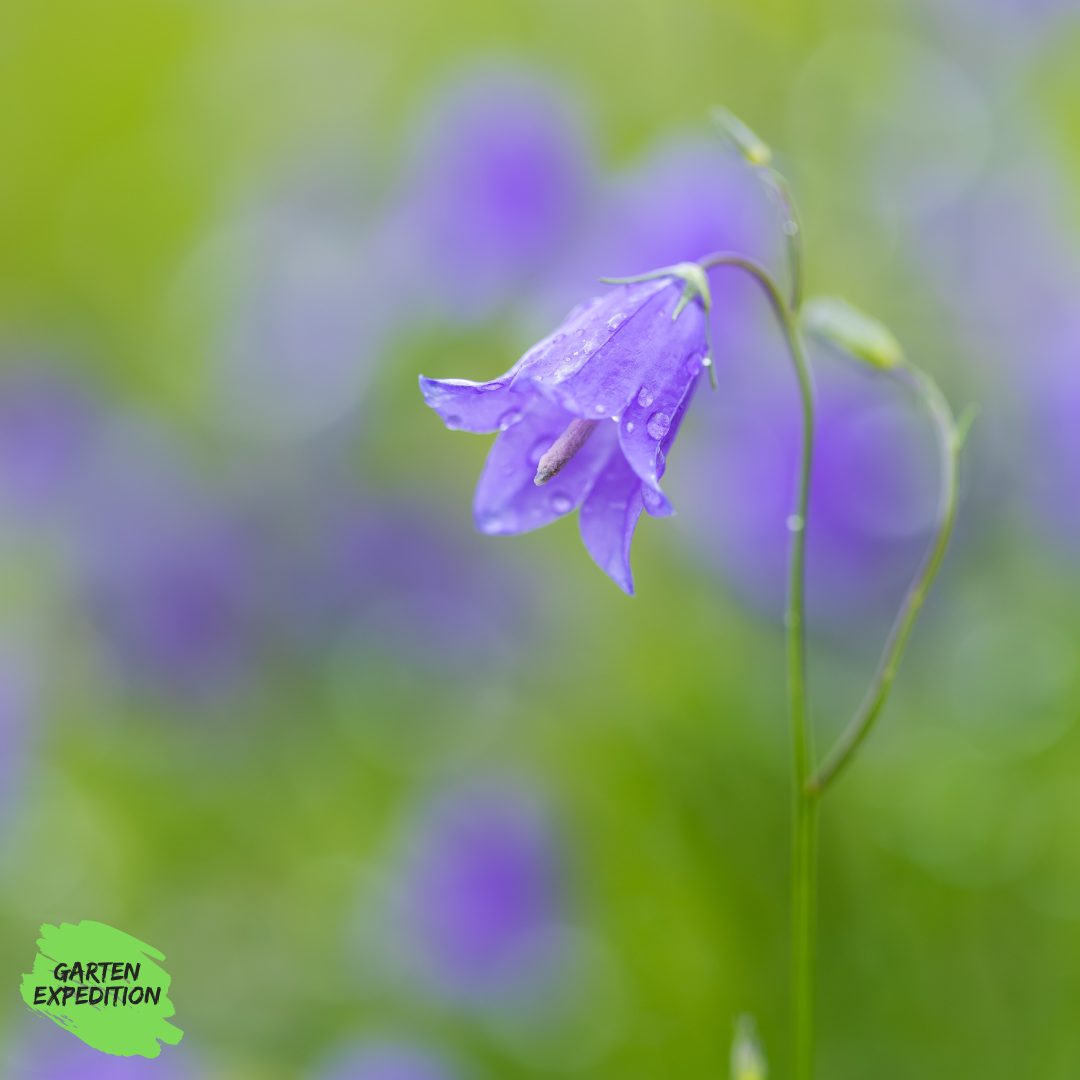
The Rampion Campanula bee (Chelostoma rapunculi) is characterised by specific behaviour: the males use the bellflowers as a sleeping quarter. They anchor themselves there with their mouthparts and remain in the flower overnight to stay protected from the elements. It is therefore essential that the flower structure has not been altered by selective breeding (so-called double varieties), as this would physically block access to the inside of the flower.
Suitability of native species for solitary bees
| Plant species (Latin) | Growth height | Ecological benefit |
|---|---|---|
| Campanula rapunculus | 40-80 cm | Pollen source for Chelostoma rapunculi |
| Campanula trachelium | 60-100 cm | Habitat for woodland and woodland-edge dwellers |
| Campanula persicifolia | 30-80 cm | Important nectar source in sunny locations |
| Campanula rotundifolia | 15-40 cm | Robust, also inhabits nutrient-poor soils |
Matching products
Available at Gartenexpedition.de
Partner note: The linked products are from Gartenexpedition.de. By purchasing, you support our work.
How to support the Rampion Campanula bee
- Species selection: Only choose native species such as the harebell (Campanula rotundifolia) or the nettle-leaved bellflower (Campanula trachelium), as these provide the evolutionarily matched pollen for Chelostoma rapunculi.
- Group planting: Plant at least three to five specimens of a single species in a group. This reduces the energy bees spend foraging.
- Maintenance timing: Avoid radical pruning in July. Only remove faded stems once they have dried out completely to avoid endangering insects that might be nesting in the pith of the stems.
- Site factors: Choose locations that match the plants' natural requirements. The peach-leaved bellflower (Campanula persicifolia), for example, prefers sunny to semi-shady positions at the edge of shrubberies.
- Avoid chemicals: Do not use pesticides, as these can cause lasting damage to the delicate system of pollinators and plants. Instead, support the natural balance in your garden.
- Nesting structures: Provide cavities in the immediate vicinity of the bellflowers. The bellflower bee is a solitary species that often uses abandoned boreholes in deadwood or pithy stems for egg-laying.
Frequently asked questions
Why are double-flowered bellflowers unsuitable for solitary bees?
Due to selective breeding, double ornamental varieties have no access to pollen and nectar. The bellflower bee cannot use these flowers as a food source.
Can I keep bellflowers in pots?
Yes, native species such as Campanula rotundifolia thrive in containers, provided they are large enough and no chemical fertilisers are used.
Keywords
All species data comes from scientific sources (CC BY 4.0 / CC0). Attribution according to licence terms. Complete source overview →