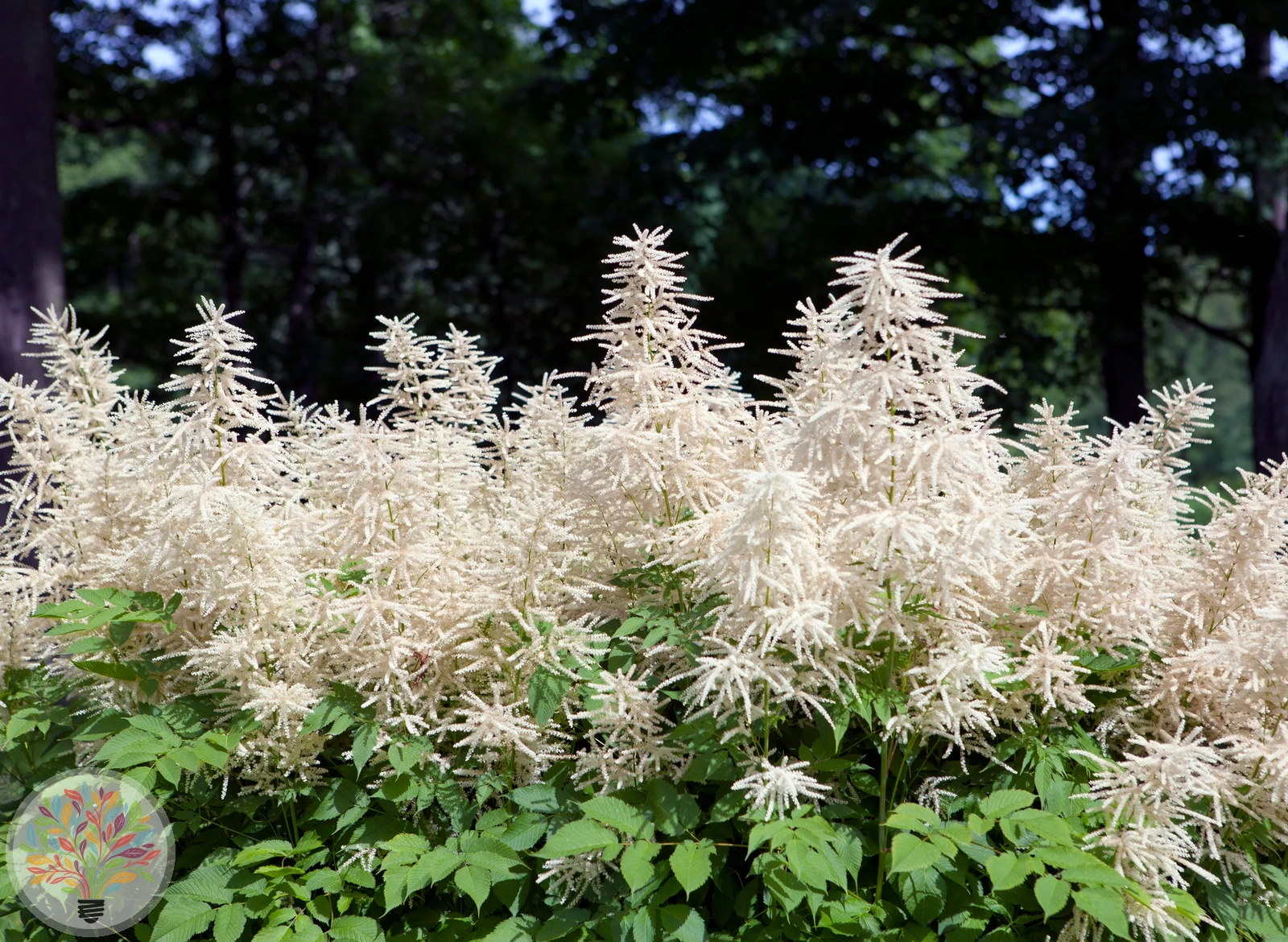
Aruncus dioicus
Aruncus dioicus
FamilyGenus: Aruncusnative in Germany
🌿
16
Species
interact
🔗
43
Interactions
documented
🐛
1
Host relationships
Species
About this species
Tall, shade-loving perennial with large, broad leaves and airy plumes of creamy-white flowers in early summer. Introduced and established in Great Britain, it favours moist, nutrient-rich, calcareous soils and adds a light, airy presence to damp woodland gardens.
Ecological network
Click to highlight connections · Click again to open the species page
Loading network...
PollinationLarval hostFlower visit
Ecological significance
This species is introduced and has established populations in Great Britain. No further ecological impact data is recorded.
Annual cycle
In spring, new foliage appears from the crown. Large, broad leaves unfurl, and by early summer tall stems carry open, airy flower plumes in June and July. Seeds ripen through late summer and are dispersed. Foliage dies back in autumn, and the plant remains dormant over winter.
Safety note
No specific safety concerns are documented for this plant.
Standort & Merkmale
Light
Schatten
Moisture
Frisch (Mäßig feucht)
Soil
Starkzehrer (Nährstoffreicher/Fetter Boden)
Flowering period
Jun – Jul
Soil reaction
Mäßig sauer bis neutral
Bioregion
Continental
Growth form
Krautige Pflanze
Woodiness
Nicht verholzt
Leaf type
Breitblättrig
Plant height
1.103 m
Morphological traits: TRY ID3 (CC BY 3.0) & TRY ID81 (CC BY)
Pflege & Anbau
Plant in partial to full shade in humus-rich, moisture-retentive but well-drained soil. A neutral to alkaline pH is ideal. Incorporate plenty of organic matter such as leaf mould or well-rotted compost before planting. Water regularly during dry spells to keep the soil consistently moist. Apply an annual mulch of garden compost or shredded bark in spring. The plant needs little pruning apart from cutting back spent flower stems and old foliage in late autumn. Divide congested clumps every three to five years in autumn or early spring to maintain flowering vigour.
Scientific profile
Aruncus dioicus is a herbaceous perennial reaching about 1.1 m in height, with a clump-forming habit and large, broad leaves. From June to July it produces striking, branched inflorescences of tiny creamy-white flowers. The plant is non-woody, terrestrial, and grows in shaded places. Its ecological preferences include moderate moisture, nutrient-rich, calcareous to basic soils, and low disturbance. Ellenberg indicator values place it in shade (light value 4), fresh to moist conditions (moisture 6), basic reaction (7), and high nutrient levels (8). The large leaf area (around 0.097 m²) and minute seeds (diaspore mass 0.0881 mg) reflect its adaptation to stable, fertile, shaded habitats such as woodland edges. In Great Britain, Aruncus dioicus is an introduced species that has become established in the wild.
Pollinators & visitors
8 Arten interagieren mit dieser Pflanze
Host relationships
1 species use this plant as a host
Sphinx ligustri
Other flower visitors
7 other species visit the flowers
Orsodacne cerasiOedemera podagrariaeBruchidius villosusAnthrenus verbasciMalachius bipustulatusMisumena vatiaCantharis fusca
Sources & data origin
•Interaktionsdaten via GloBI (CC-BY 4.0)
•pollinator_interactions
•FloraWeb / BfN
•EIVE 1.0 — Dengler et al. (2023), DOI: 10.3897/VCS.98324 (CC BY 4.0)
•GBIF Backbone Taxonomy — GBIF Secretariat (2024), DOI: 10.15468/39omei (CC BY 4.0)
•TRY Categorical Traits (ID3) — Kattge et al. (2012), DOI: 10.17871/TRY.3 (CC BY 3.0)
•TRY Global Spectrum (ID81) — Díaz et al. (2016/2021), DOI: 10.17871/TRY.81 (CC BY)
•Checklist Alien Plants Belgium — Verloove F (2023), Botanic Garden Meise (CC BY 4.0)
•Govaerts R et al. (2025) — World Checklist of Vascular Plants (WCVP) v14. Royal Botanic Gardens, Kew. DOI: 10.34885/xs7h-ze42 (CC BY 4.0)
•Foto: © Adobe Stock / AdobeStock_79965994
All data is licensed under CC BY 4.0, CC0, or compatible terms. Attribution according to license conditions. Full source overview →