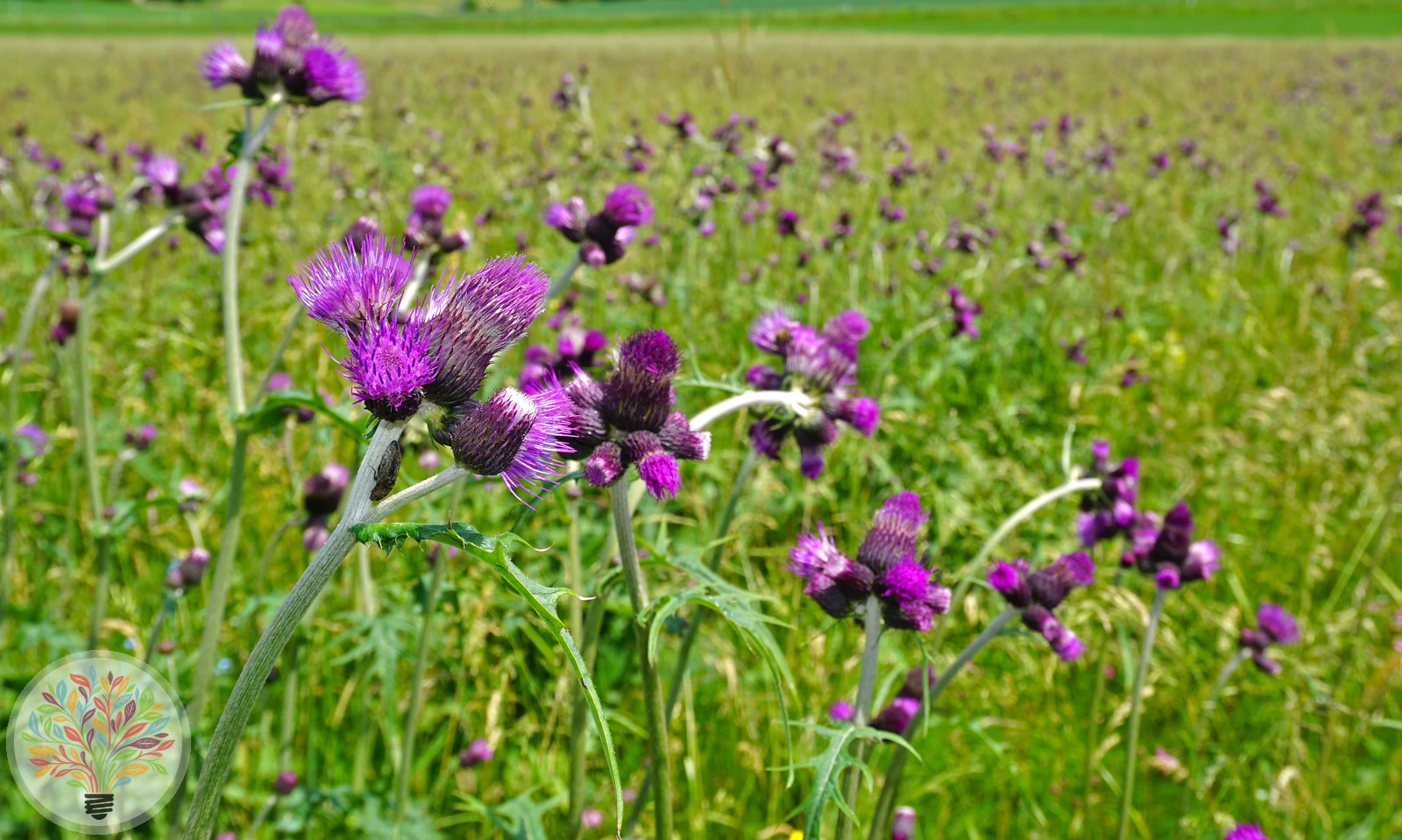
Cirsium palustre
Cirsium palustre
FamilyGenus: Cirsiumnative in Germany
🌿
155
Species
interact
🔗
856
Interactions
documented
🐛
6
Host relationships
Species
About this species
Cirsium palustre is a native herbaceous perennial of damp meadows and woodland edges. It bears flower heads from June to October and reaches about 0.8 m in height.
Ecological network
Click to highlight connections · Click again to open the species page
Loading network...
PollinationLarval hostFlower visit
Ecological significance
Cirsium palustre is a characteristic species of damp grassland and woodland-edge communities in Great Britain.
Annual cycle
A herbaceous perennial that begins new growth in spring. Flower heads are produced from June to October. The foliage dies back in late autumn, with the plant persisting over winter as underground parts.
Standort & Merkmale
Light
Sonne
Moisture
Frisch (Mäßig feucht)
Soil
Mittelzehrer (Normaler Boden)
Flowering period
Jun – Okt
Soil reaction
Mäßig sauer bis neutral
Bioregion
Continental
Growth form
Krautige Pflanze
Woodiness
Nicht verholzt
Leaf type
Breitblättrig
Plant height
0.802 m
Morphological traits: TRY ID3 (CC BY 3.0) & TRY ID81 (CC BY)
Corolla tube
3 mm
Nectar
0.6393 µl/Blüte
Pollen
5.0533 mg/Blüte
Pflege & Anbau
Grow in full sun in moisture-retentive, moderately fertile soil. Cirsium palustre is suited to damp meadow plantings and wildflower areas where the ground remains moist during the growing season. It tolerates neutral to slightly acidic conditions and requires little maintenance once established.
Scientific profile
Cirsium palustre is a herbaceous broad-leaved plant, native in Great Britain. Non-woody and typically reaching around 0.8 metres tall, it grows in sunny locations on moist, neutral to slightly acidic soils. It occurs naturally in fresh, moderately nutrient-poor meadows and along woodland fringes, often in places with minimal disturbance. The flower heads appear from June through to October. The leaves are broad, and the plant has a terrestrial growth habit.
Pollinators & visitors
126 Arten interagieren mit dieser Pflanze
Vanessa carduiBombus ruderariusBombus jonellusPieris napiPolyommatus icarusPolygonia c-albumPieris rapaethecla betulaeThymelicus lineolaThymelicus sylvestrisAphantopus hyperantusSphecodes reticulatusLasioglossum fratellumLasioglossum leucozoniumSphecodes geoffrellusHalictus tumulorumMelanargia galatheaFabriciana adippeManiola jurtinaLysandra bellargusSphecodes monilicornisCelastrina argiolusAricia agestisBombus rupestrisPanurgus banksianusMelitaea athaliaOsmia leaianaBombus sylvarumPapilio machaonLasioglossum morioSpeyeria aglajaPieris brassicaeBombus vestalisEuphydryas auriniaErynnis tagesAglais urticaeLysandra coridonPararge aegeriaHipparchia semeleLycaena phlaeasLasioglossum albipesBombus barbutellusBombus monticolaAnthophora bimaculataBombus humilisBombus bohemicusBombus hortorumAndrena pilipesAndrena flavipesAndrena denticulata
Host relationships
6 species use this plant as a host
Ceramica pisiXylena vetustaAutographa gammaLarinus turbinatusAgapanthia villosoviridescensTrichius fasciatus
Other flower visitors
23 other species visit the flowers
Rhagonycha fulvaPatania ruralisFormica fuscaCassida vibexEnoplognatha ovataErythromma najasCoccinella septempunctataMisumena vatiaDolycoris baccarum (Linnaeus,1758)Palomena prasina (Linnaeus,1761)PsithyrusStenurella melanuraDrymeia hamataNeocrepidodera transversaMusca autumnalisSarcophaga variegataBellardia pandiaEmpis lividaEmpis scoticaScathophaga stercorariaSarcophaga carnariaPegoplata aestivaHylemya vagans
Sources & data origin
•Cook et al. (2025) UK Butterfly & Moth Traits (DOI: 10.5285/dbc7cc17-cbbd-49dd-bab4-8e8855768d66)
•Interaktionsdaten via GloBI (CC-BY 4.0)
•FloRes_2022
•pollinator_interactions
•Baden-Böhm F, App M, Thiele J (2022) — The FloRes Database: A floral resources trait database for pollinator habitat-assessment generated by a multistep workflow. Johann Heinrich von Thünen-Institut, Dryad, DOI: 10.5061/dryad.djh9w0w29 (CC0)
•FloraWeb / BfN
•EIVE 1.0 — Dengler et al. (2023), DOI: 10.3897/VCS.98324 (CC BY 4.0)
•GBIF Backbone Taxonomy — GBIF Secretariat (2024), DOI: 10.15468/39omei (CC BY 4.0)
•TRY Categorical Traits (ID3) — Kattge et al. (2012), DOI: 10.17871/TRY.3 (CC BY 3.0)
•TRY Global Spectrum (ID81) — Díaz et al. (2016/2021), DOI: 10.17871/TRY.81 (CC BY)
•Govaerts R et al. (2025) — World Checklist of Vascular Plants (WCVP) v14. Royal Botanic Gardens, Kew. DOI: 10.34885/xs7h-ze42 (CC BY 4.0)
•Foto: © Copyright© Jürgen Vogt All Rights Reserved / Adobe Stock / AdobeStock_446959000
All data is licensed under CC BY 4.0, CC0, or compatible terms. Attribution according to license conditions. Full source overview →