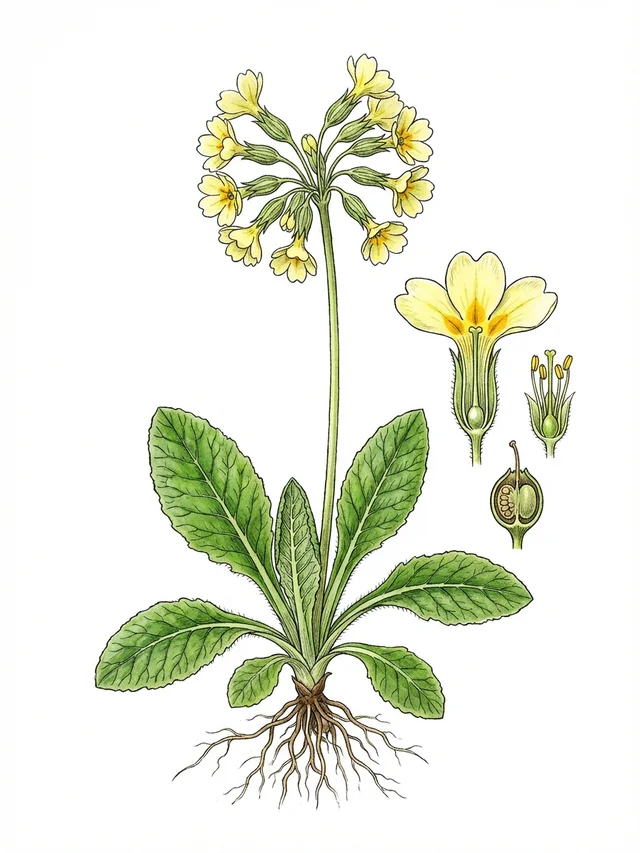
 Image to followAI-generated illustration
Equisetum telmateia
Equisetum telmateia
FamilyGenus: Equisetumnative in Germany
🌿
5
Species
interact
🔗
5
Interactions
documented
About this species
A native, evergreen horsetail reaching over a metre in height, Equisetum telmateia bears fertile stems between April and May and persists with photosynthetic shoots in moist, lime-rich, semi-shaded sites.
Ecological network
Click to highlight connections · Click again to open the species page
Loading network...
Pollination
Ecological significance
Equisetum telmateia typically occurs in damp, base-rich habitats such as fens, flushes and seepages, where it can form extensive stands. It contributes to the structure of these communities and forms arbuscular mycorrhizal associations.
Annual cycle
Equisetum telmateia is evergreen, with photosynthetic stems persisting throughout the year. Fertile, spore-producing shoots are produced from April to May, followed by the further development of the sterile green stems.
Standort & Merkmale
Light
Halbschatten
Moisture
Frisch (Mäßig feucht)
Soil
Mittelzehrer (Normaler Boden)
Flowering period
Apr – Mai
Soil reaction
Basisch / Kalkhold
Bioregion
Continental
Growth form
Farn
Woodiness
Nicht verholzt
Leaf type
Photosynthetischer Spross
Leaf phenology
Immergrün
Plant height
1.168 m
Morphological traits: TRY ID3 (CC BY 3.0) & TRY ID81 (CC BY)
Pflege & Anbau
Provide a consistently moist, lime-rich substrate in partial shade. The plant spreads naturally from spores and can form colonies once established.
Scientific profile
Equisetum telmateia is a terrestrial, non-woody horsetail that typically attains about 1.2 metres in height. Its photosynthetic shoots serve as the main assimilatory organs, with a leaf area of around 50 mm², and the species disperses via minute spores (diaspore mass effectively zero). Fertile stems appear from April to May. The plant is evergreen and occupies moist to wet, calcareous soils in semi-shaded conditions where disturbance is low. In Great Britain it is a native species.
Pollinators & visitors
5 Arten interagieren mit dieser Pflanze
Sources & data origin
•Interaktionsdaten via GloBI (CC-BY 4.0)
•FloraWeb / BfN
•EIVE 1.0 — Dengler et al. (2023), DOI: 10.3897/VCS.98324 (CC BY 4.0)
•GBIF Backbone Taxonomy — GBIF Secretariat (2024), DOI: 10.15468/39omei (CC BY 4.0)
•TRY Categorical Traits (ID3) — Kattge et al. (2012), DOI: 10.17871/TRY.3 (CC BY 3.0)
•TRY Global Spectrum (ID81) — Díaz et al. (2016/2021), DOI: 10.17871/TRY.81 (CC BY)
•Govaerts R et al. (2025) — World Checklist of Vascular Plants (WCVP) v14. Royal Botanic Gardens, Kew. DOI: 10.34885/xs7h-ze42 (CC BY 4.0)
All data is licensed under CC BY 4.0, CC0, or compatible terms. Attribution according to license conditions. Full source overview →