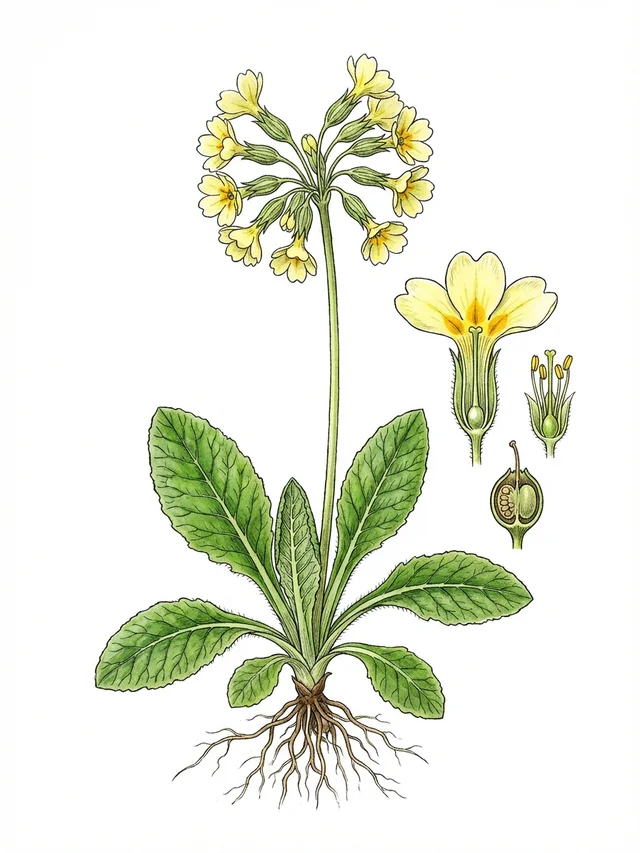
 Image to followAI-generated illustration
Erica tetralix
Erica tetralix
FamilyGenus: Ericanative in Germany
🌿
127
Species
interact
🔗
615
Interactions
documented
🐛
15
Host relationships
Species
About this species
A native, low-growing evergreen shrub of wet heathland and acid moorland, bearing needle-like leaves and flowering from May to July.
Ecological network
Click to highlight connections · Click again to open the species page
Loading network...
PollinationLarval hostFlower visit
Ecological significance
As a native component of damp heathland and acid bog communities, Erica tetralix is well adapted to its natural habitat. Its ecological interactions are not detailed in the available evidence.
Annual cycle
An evergreen shrub that retains its needle-like leaves all year. Bloom takes place between May and July, after which minute seeds are released.
Standort & Merkmale
Light
Sonne
Moisture
Feucht
Soil
Schwachzehrer (Magerer Boden)
Flowering period
Mai – Jul
Soil reaction
Sauer (Säurezeiger)
Bioregion
Continental
Growth form
Strauch
Woodiness
Verholzt
Leaf type
Nadelblättrig
Leaf phenology
Immergrün
Plant height
0.334 m
Morphological traits: TRY ID3 (CC BY 3.0) & TRY ID81 (CC BY)
Pflege & Anbau
•
Light: Full sun.
•
Soil: Moist to wet, strongly acid, and low in nutrients – ideally a sandy or peaty mix.
•
Watering: Keep the root zone consistently moist; do not allow to dry out.
•
Feeding: No additional fertiliser is needed; it is a plant of lean, impoverished soils.
Scientific profile
Erica tetralix belongs to the Ericaceae family. It is native in Great Britain, where it forms a woody, evergreen shrub reaching about 33 cm in height. The short, needle-like leaves are held throughout the year. Flowers appear from May to July. The plant is adapted to full sun and requires consistently moist to wet, strongly acid, nutrient-poor soils. It shows little tolerance of disturbance and thrives in low-fertility conditions.
Pollinators & visitors
88 Arten interagieren mit dieser Pflanze
Plebejus argusBombus pascuorumLycaena phlaeasNomada fabricianaErebia aethiopsAglais urticaeLasioglossum calceatumBombus muscorumAndrena ovatulaBombus magnusAndrena bicolorBombus pratorumBombus hortorumBombus hypnorumBombus lapidariusBombus jonellusBombus terrestrisApis melliferaBoloria seleneCoenonympha pamphilusBombus sylvarumBombus lucorumPolygonia c-albumLasioglossum leucozoniumBombus vestalisHalictus rubicundusAricia agestisAndrena dorsataSpeyeria aglajaBombus campestrisPhilanthus triangulumBombus ruderariusNomada flavopictaBombus humilisBombus sylvestrisAnthophora furcataBombus bohemicusLasioglossum fratellumAphantopus hyperantusLycophotia porphyreaAndrena wilkellaAnastrangalia sanguinolentaCeriagrion tenellumBombus monticolaBrenthis inoCrocothemis erythraeaAthalia rosaeBombus rupestrisMegachile versicolorAdscita statices
Host relationships
15 species use this plant as a host
Callophrys rubiMacrothylacia rubiScopula ternataPachycnemia hippocastanariaCleora cinctariaGnophos obfuscata (Denis & Schiffermüller), 1775Chlorissa viridataXestia castaneaEmaturga atomariaEntephria caesiataDicallomera fascelinaEupithecia satyrataSelidosema brunneariaSaturnia pavoniaAcronicta menyanthidis
Other flower visitors
24 other species visit the flowers
Pyrrhula pyrrhulaFormica rufaRhagonycha fulvaFormica fuscaoedemera luridaStenurella melanuraNeomyia cornicinaBarycnemisDolichopus rupestrisEriothrix rufomaculatusPolietes lardariaCerambycidaeBellardia vulgarisPollenia rudisHerina frondescentiaeMeligethes viridescensPhaonia incanaLinnaemya vulpinaTachina grossaCoenosia distinguensHydrotaea irritansThricops cunctansLeptura melanuraPolietes ladarius
Sources & data origin
•Cook et al. (2025) UK Butterfly & Moth Traits (DOI: 10.5285/dbc7cc17-cbbd-49dd-bab4-8e8855768d66)
•Interaktionsdaten via GloBI (CC-BY 4.0)
•pollinator_interactions
•Baden-Böhm F, App M, Thiele J (2022) — The FloRes Database: A floral resources trait database for pollinator habitat-assessment generated by a multistep workflow. Johann Heinrich von Thünen-Institut, Dryad, DOI: 10.5061/dryad.djh9w0w29 (CC0)
•FloraWeb / BfN
•EIVE 1.0 — Dengler et al. (2023), DOI: 10.3897/VCS.98324 (CC BY 4.0)
•GBIF Backbone Taxonomy — GBIF Secretariat (2024), DOI: 10.15468/39omei (CC BY 4.0)
•TRY Categorical Traits (ID3) — Kattge et al. (2012), DOI: 10.17871/TRY.3 (CC BY 3.0)
•TRY Global Spectrum (ID81) — Díaz et al. (2016/2021), DOI: 10.17871/TRY.81 (CC BY)
•Govaerts R et al. (2025) — World Checklist of Vascular Plants (WCVP) v14. Royal Botanic Gardens, Kew. DOI: 10.34885/xs7h-ze42 (CC BY 4.0)
All data is licensed under CC BY 4.0, CC0, or compatible terms. Attribution according to license conditions. Full source overview →