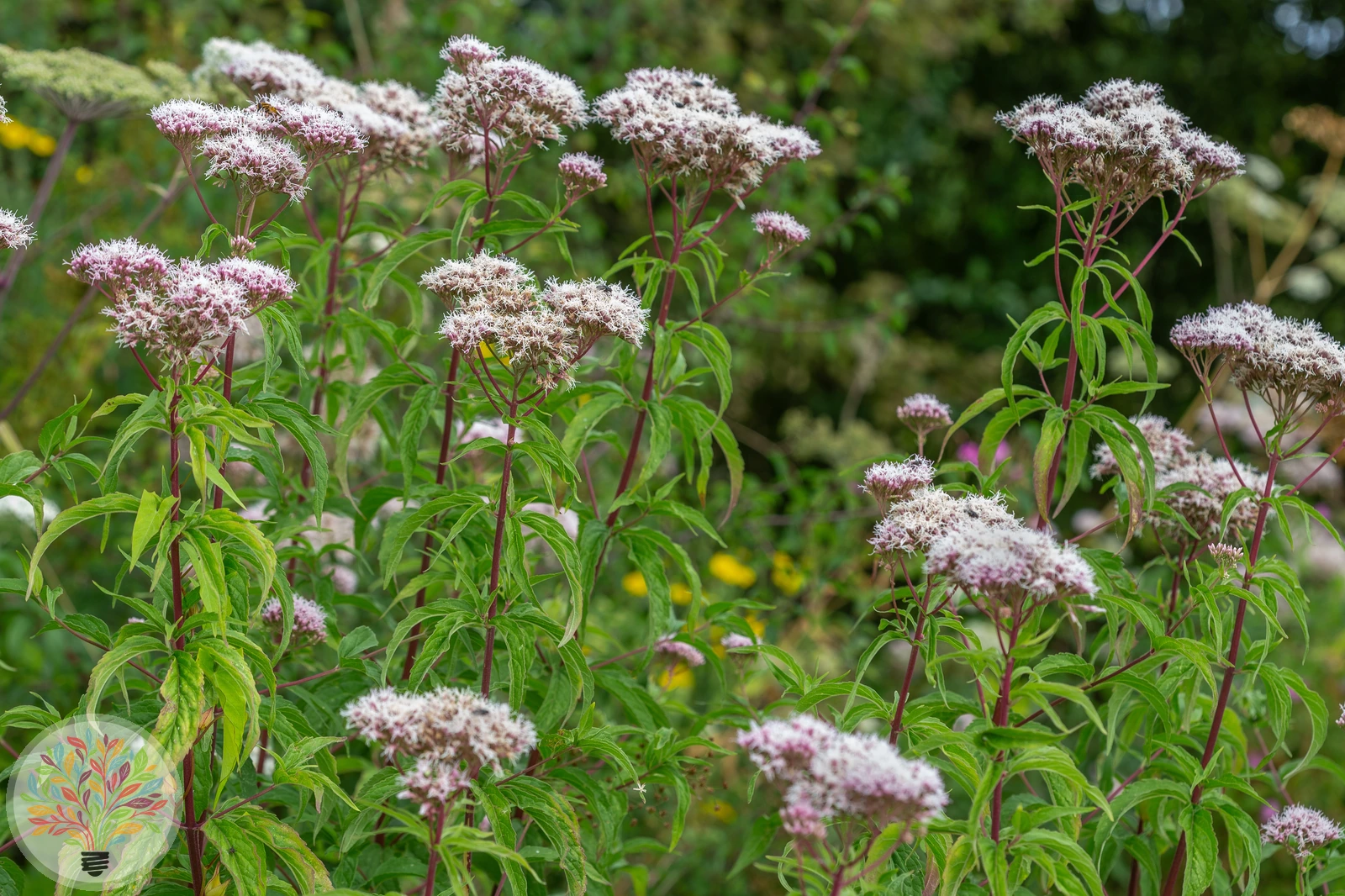
Eupatorium cannabinum
Eupatorium cannabinum
FamilyGenus: Eupatoriumnative in Germany
🌿
100
Species
interact
🔗
252
Interactions
documented
🐛
11
Host relationships
Species
About this species
Eupatorium cannabinum is a native herbaceous plant of damp, nutrient-rich, calcareous habitats, flowering from July to September.
Ecological network
Click to highlight connections · Click again to open the species page
Loading network...
PollinationLarval hostFlower visit
Ecological significance
As a native species, it forms part of the natural herbaceous flora of damp, nutrient-rich, calcareous habitats.
Annual cycle
Flowers from July to September.
Standort & Merkmale
Light
Halbschatten
Moisture
Frisch (Mäßig feucht)
Soil
Starkzehrer (Nährstoffreicher/Fetter Boden)
Flowering period
Jul – Sep
Soil reaction
Basisch / Kalkhold
Bioregion
Continental
Growth form
Krautige Pflanze
Woodiness
Nicht verholzt
Leaf type
Breitblättrig
Plant height
0.594 m
Morphological traits: TRY ID3 (CC BY 3.0) & TRY ID81 (CC BY)
Nectar
2.5169 µl/Blüte
Pflege & Anbau
•
Light: partial shade
•
Soil: nutrient-rich, moderately moist to damp
•
Flowers: July–September
Scientific profile
Eupatorium cannabinum is a native herbaceous plant, non-woody and broad-leaved. It typically reaches a height of about 0.6 metres. The leaf area averages 1414 mm², and the minute seeds weigh approximately 0.31 mg. In terms of ecological preferences, it favours sunny to partially shaded positions (Ellenberg light value 7), damp soils (moisture value 7), and nutrient-rich conditions (nutrient value 7). It occurs on calcareous or basic soils (reaction value 7), is intolerant of salt (salinity value 0), and is associated with low-disturbance habitats (disturbance severity 0.52). Flowering takes place from July to September.
Pollinators & visitors
68 Arten interagieren mit dieser Pflanze
Lasioglossum morioLasioglossum laticepsColletes hederaeAndrena flavipesBombus lapidariusHalictus scabiosaeBombus terrestrisBombus pascuorumBombus terrestris/lucorumEristalis similisBombus soroeensisSphegina sibiricaMelanostoma mellinumEristalis arbustorumSyritta pipiensEristalis tenaxEpisyrphus balteatusCelastrina argiolusEctemnius lituratusAndrena ovatulaManiola jurtinaPolygonia c-albumPyronia tithonusPararge aegeriaSphecodes albilabrisSyrphus vitripennisEristalis pertinaxBombus hortorumBombus lucorumBombus hypnorumBombus vestalisBombus humilisBombus campestrisBombus bohemicusBombus pratorumBombus sylvestrisAglais urticaePieris napiPieris rapaePieris brassicaeVanessa atalantaVolucella inanisVolucella zonariaVolucella pellucensVolucella bombylansSyrphus ribesiiPlatycheirus manicatusSphaerophoria scriptaBombus ruderariusAglais io
Host relationships
11 species use this plant as a host
Callimorpha dominulaDiachrysia chrysonAutographa bracteaGortyna flavagoDiachrysia chrysitisEupithecia subfuscataChloroclystis v-ataEuplagia quadripunctariaSaturnia pavoniaEupithecia absinthiataEupithecia centaureata
Other flower visitors
21 other species visit the flowers
Conops flavipesRhagonycha fulvaSarcophaga dissimilisPollenia rudisPyrausta aurataCalliphora vicinaMyrmica rubraSiphona geniculataEusphalerum luteumEriothrix rufomaculataEurithia anthophilaCalliphora vomitoriaMyrmica scabrinodisMeligethes aeneusRhamphomyia variabilisCetonia aurataThecophora atraLucilia caesarSarcophaga nigriventrisScathophaga stercorariaMorellia aenescens
Sources & data origin
•Cook et al. (2025) UK Butterfly & Moth Traits (DOI: 10.5285/dbc7cc17-cbbd-49dd-bab4-8e8855768d66)
•pollinator_interactions
•Baden-Böhm F, App M, Thiele J (2022) — The FloRes Database: A floral resources trait database for pollinator habitat-assessment generated by a multistep workflow. Johann Heinrich von Thünen-Institut, Dryad, DOI: 10.5061/dryad.djh9w0w29 (CC0)
•FloraWeb / BfN
•EIVE 1.0 — Dengler et al. (2023), DOI: 10.3897/VCS.98324 (CC BY 4.0)
•GBIF Backbone Taxonomy — GBIF Secretariat (2024), DOI: 10.15468/39omei (CC BY 4.0)
•TRY Categorical Traits (ID3) — Kattge et al. (2012), DOI: 10.17871/TRY.3 (CC BY 3.0)
•TRY Global Spectrum (ID81) — Díaz et al. (2016/2021), DOI: 10.17871/TRY.81 (CC BY)
•Govaerts R et al. (2025) — World Checklist of Vascular Plants (WCVP) v14. Royal Botanic Gardens, Kew. DOI: 10.34885/xs7h-ze42 (CC BY 4.0)
•Foto: © Adobe Stock / AdobeStock_1023376598
All data is licensed under CC BY 4.0, CC0, or compatible terms. Attribution according to license conditions. Full source overview →