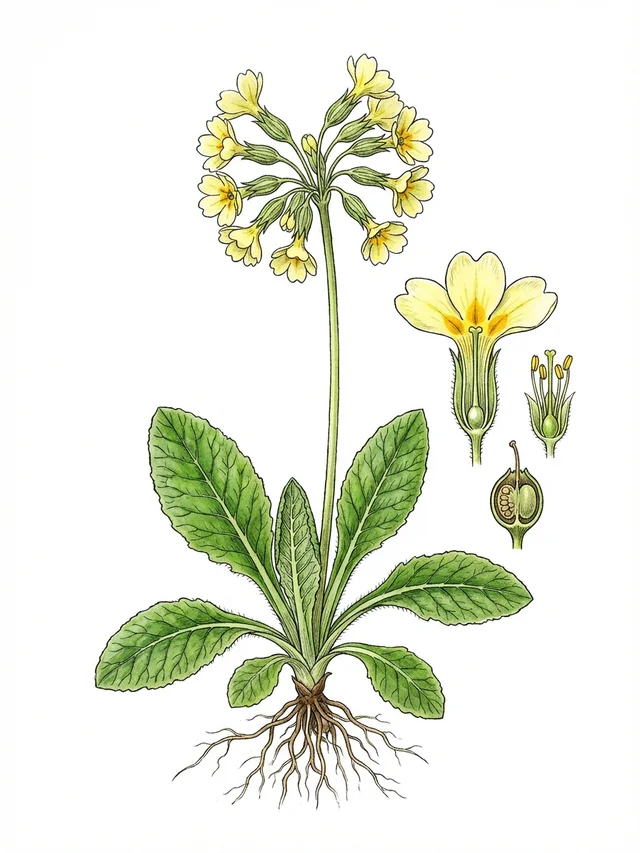
 Image to followAI-generated illustration
Eupatorium cannabinum
Eupatorium cannabinum subsp. cannabinum
FamilyGenus: Eupatoriumnative in Germany
🌿
96
Species
interact
🔗
182
Interactions
documented
🐛
1
Host relationships
Species
About this species
Eupatorium cannabinum is a native herbaceous perennial of damp, partially shaded places in Great Britain. It typically reaches around 0.6 m tall, bearing broad leaves and clusters of flowers from July to September. It thrives in moderately moist, nutrient-rich, alkaline to neutral soils.
Ecological network
Click to highlight connections · Click again to open the species page
Loading network...
PollinationLarval hostFlower visit
Ecological significance
Eupatorium cannabinum is a wild herb that flowers from July to September in its native British habitats.
Annual cycle
Top growth emerges in spring and persists until autumn; flowering stems bear broad leaves and produce flower heads from July to September. As a non-woody herbaceous plant, above-ground parts die back in winter.
Standort & Merkmale
Light
Halbschatten
Moisture
Frisch (Mäßig feucht)
Soil
Starkzehrer (Nährstoffreicher/Fetter Boden)
Flowering period
Jul – Sep
Soil reaction
Basisch / Kalkhold
Bioregion
Continental
Growth form
Krautige Pflanze
Woodiness
Nicht verholzt
Leaf type
Breitblättrig
Plant height
0.594 m
Morphological traits: TRY ID3 (CC BY 3.0) & TRY ID81 (CC BY)
Pflege & Anbau
•
Light: partial shade.
•
Moisture: keep the soil fairly moist but not waterlogged.
•
Soil: fertile, alkaline to neutral soil.
Scientific profile
Eupatorium cannabinum is a member of the Asteraceae (daisy) family, native in Great Britain. It is a non-woody herbaceous perennial with broad, simple leaves. The plant typically attains a height of about 0.6 m. Flowering occurs from July through September, producing terminal inflorescences. The species favours semi-shaded situations, moderately moist soils and nutrient-rich, alkaline to neutral substrates. Diaspores are small, averaging 0.31 mg in mass.
Pollinators & visitors
82 Arten interagieren mit dieser Pflanze
Pararge aegeriaPieris brassicaeLasioglossum albipesBombus jonellusEuplagia quadripunctariaPolyommatus icarusPieris rapaeThymelicus sylvestrisBombus terrestrisAricia agestisManiola jurtinaSpeyeria aglajaHylaeus communisLysandra bellargusLasiommata megeraFabriciana adippePapilio machaonAphantopus hyperantusBombus pascuorumBombus lucorumSatyrium w-albumAglais urticaeBombus lapidariusHeriades truncorumLasioglossum calceatumBombus vestalisBombus sylvestrisCelastrina argiolusBombus humilisPyrausta aurataBombus ruderariusPieris napiBombus hypnorumBombus pratorumPyronia tithonusAndrena flavipesBombus campestrisAglais ioEctemnius lituratusApis melliferaIssoria lathoniaGymnoscelis rufifasciataMinois dryasLycaena virgaureaePolygonia c-albumVanessa atalantaAmata phegeaMellicta athaliaScolia hirtaZygaena transalpina
Host relationships
1 species use this plant as a host
Chloroclystis v-ata
Other flower visitors
13 other species visit the flowers
Myrmica rubraCetonia aurataRhagonycha fulvaMyrmica scabrinodisBrassicogethes aeneusCoccinella septempunctataMisumena vatiaPatania ruralisStictoleptura rubraPhalangium opilioUdea ferrugalisCydalima perspectalisLygistopterus sanguineus
Sources & data origin
•Interaktionsdaten via GloBI (CC-BY 4.0)
•FloraWeb / BfN
•EIVE 1.0 — Dengler et al. (2023), DOI: 10.3897/VCS.98324 (CC BY 4.0)
•GBIF Backbone Taxonomy — GBIF Secretariat (2024), DOI: 10.15468/39omei (CC BY 4.0)
•TRY Categorical Traits (ID3) — Kattge et al. (2012), DOI: 10.17871/TRY.3 (CC BY 3.0)
•TRY Global Spectrum (ID81) — Díaz et al. (2016/2021), DOI: 10.17871/TRY.81 (CC BY)
•Govaerts R et al. (2025) — World Checklist of Vascular Plants (WCVP) v14. Royal Botanic Gardens, Kew. DOI: 10.34885/xs7h-ze42 (CC BY 4.0)
All data is licensed under CC BY 4.0, CC0, or compatible terms. Attribution according to license conditions. Full source overview →