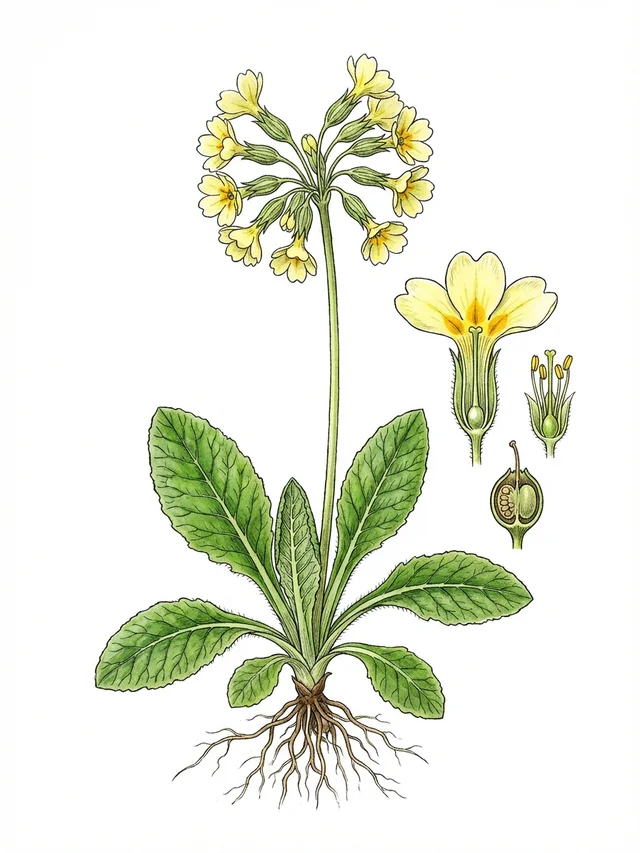
 Image to followAI-generated illustration
Galium verum
Galium verum subsp. verum
FamilyGenus: Labkräuternative in Germany
🌿
48
Species
interact
🔗
55
Interactions
documented
🐛
18
Host relationships
Species
About this species
Galium verum is a native perennial of dry, calcareous grasslands. It grows to about 35 cm and bears frothy clusters of tiny yellow flowers during summer.
Ecological network
Click to highlight connections · Click again to open the species page
Loading network...
PollinationLarval hostFlower visit
Ecological significance
Its flowers are visited by pollinating insects, contributing to local biodiversity in dry grassland habitats.
Annual cycle
A perennial that dies back to ground level each winter. New shoots emerge in spring; flowering occurs from June to August; seeds ripen in late summer and early autumn, and the plant then senesces in autumn.
Safety note
No specific safety information is available for this species.
Standort & Merkmale
Light
Sonne
Moisture
Trocken
Soil
Schwachzehrer (Magerer Boden)
Flowering period
Jun – Aug
Soil reaction
Basisch / Kalkhold
Bioregion
Continental
Growth form
Krautige Pflanze
Woodiness
Nicht verholzt
Leaf type
Breitblättrig
Plant height
0.335 m
Morphological traits: TRY ID3 (CC BY 3.0) & TRY ID81 (CC BY)
Pflege & Anbau
*Plant in full sun in very well‑drained, low‑fertility soil. Water sparingly once established; it thrives in dry, lean conditions. Cut back after flowering if desired. No routine feeding is needed. Propagation by seed sown in autumn or by division in spring.*
Scientific profile
Galium verum is a herbaceous perennial in the bedstraw family (Rubiaceae). Its slender, four-angled stems reach around 35 cm in height and bear whorls of small, bright green leaves. The plant is non‑woody and entirely terrestrial. From June to August, dense terminal panicles of tiny, golden‑yellow flowers appear and are visited by insects. The flowers give way to small, two‑lobed seed capsules. Galium verum is native in Great Britain and is characteristic of dry, nutrient‑poor, calcareous soils, particularly in chalk and limestone grassland and dry meadows. It forms arbuscular mycorrhizal associations, aiding nutrient uptake in poor substrates.
Pollinators & visitors
20 Arten interagieren mit dieser Pflanze
Thymelicus lineolaCoenonympha pamphilusAndrena minutulaPlebejus argusHalictus tumulorumLasioglossum fulvicorneVespula vulgarisSphecodes crassusBombus sylvestrisBombus pascuorumBombus lucorumBombus lapidariusLasioglossum pauxillummacroglossum stellatarumAndrena subopacaSatyrus ferulaCrambus perlellusLycaena virgaureaeThymelicus sylvestrisFabriciana niobe
Host relationships
18 species use this plant as a host
Deilephila elpenorPolia bombycinaCucullia umbraticaAmphipyra tragopoginisChiasmia clathrataSiona lineataEpirrhoe galiataEpirrhoe alternataCosmorhoe ocellataEulithis pyraliata (Denis & Schiffermüller), 1775Epirrhoe tristataCamptogramma bilineataXanthorhoe spadiceariaDeilephila porcellusCatarhoe cuculataXestia xanthographaXanthorhoe montanataXanthorhoe ferrugata
Other flower visitors
10 other species visit the flowers
Formica fuscaMyrmica lobicornisSerica brunneaAglaostigma fulvipesCapreolus capreolusBrassicogethes aeneusoedemera luridaCetonia aurataSermylassa halensisAgrypnus murinus
Sources & data origin
•Interaktionsdaten via GloBI (CC-BY 4.0)
•FloraWeb / BfN
•EIVE 1.0 — Dengler et al. (2023), DOI: 10.3897/VCS.98324 (CC BY 4.0)
•GBIF Backbone Taxonomy — GBIF Secretariat (2024), DOI: 10.15468/39omei (CC BY 4.0)
•TRY Categorical Traits (ID3) — Kattge et al. (2012), DOI: 10.17871/TRY.3 (CC BY 3.0)
•TRY Global Spectrum (ID81) — Díaz et al. (2016/2021), DOI: 10.17871/TRY.81 (CC BY)
•Checklist Alien Plants Belgium — Verloove F (2023), Botanic Garden Meise (CC BY 4.0)
•Govaerts R et al. (2025) — World Checklist of Vascular Plants (WCVP) v14. Royal Botanic Gardens, Kew. DOI: 10.34885/xs7h-ze42 (CC BY 4.0)
All data is licensed under CC BY 4.0, CC0, or compatible terms. Attribution according to license conditions. Full source overview →