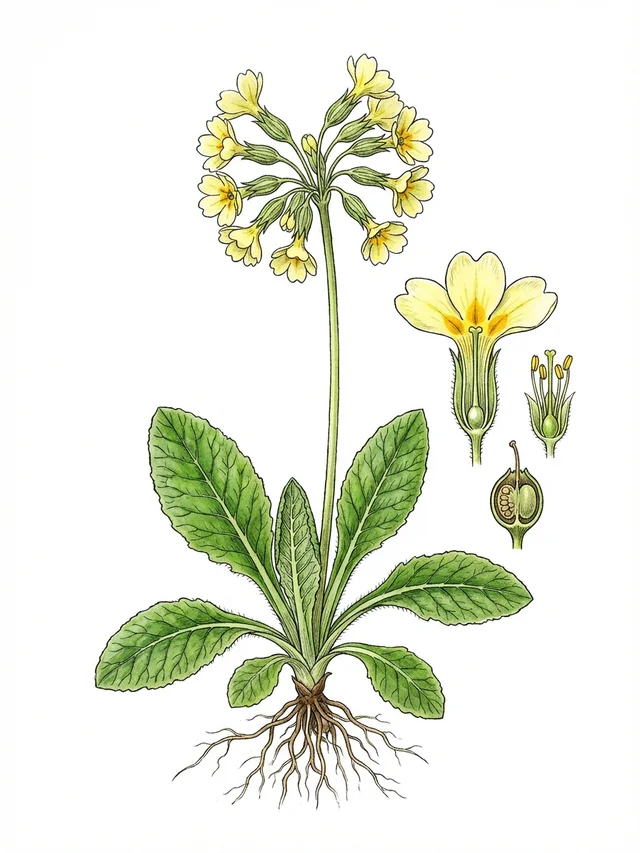
 Image to followAI-generated illustration
Inula helenium
Inula helenium
FamilyGenus: Inulanative in Germany
🌿
34
Species
interact
🔗
41
Interactions
documented
About this species
Inula helenium is a tall, herbaceous perennial archaeophyte in the British flora, long established since before 1500. It bears large, bright yellow daisy-like flowers from June to August and favours sunny sites with moderately moist, average garden soil.
Ecological network
Click to highlight connections · Click again to open the species page
Loading network...
PollinationFlower visit
Ecological significance
The available evidence does not document any negative ecological impact in Great Britain.
Annual cycle
In spring, broad leaves emerge from the ground. Tall flowering stems develop, bearing large yellow flowerheads from June through August. Seed heads follow, and the foliage senesces by late autumn.
Standort & Merkmale
Light
Sonne
Moisture
Frisch (Mäßig feucht)
Soil
Mittelzehrer (Normaler Boden)
Flowering period
Jun – Aug
Soil reaction
Mäßig sauer bis neutral
Bioregion
Continental
Growth form
Krautige Pflanze
Woodiness
Nicht verholzt
Leaf type
Breitblättrig
Plant height
1.368 m
Morphological traits: TRY ID3 (CC BY 3.0) & TRY ID81 (CC BY)
Pflege & Anbau
**Position:** Full sun.
**Soil:** Moderately moist, average garden soil (neutral to slightly acid).
**Height:** Can reach around 1.37 m; may benefit from discreet staking in exposed situations.
**Maintenance:** Low disturbance tolerance suggests minimal soil cultivation around the crown. The plant forms arbuscular mycorrhizal associations, so avoid excessive use of high-phosphate fertilisers.
Scientific profile
Inula helenium is an archaeophyte in Great Britain, first recorded prior to AD 1500 and now thoroughly naturalised. This herbaceous member of the Asteraceae family develops a basal rosette of broad leaves and sends up stout, unbranched flowering stems that typically reach 1.37 m in height. The showy, yellow composite flowerheads appear from June through August. It is a non-woody species with large leaf blades (average area 3241 mm²). Its ecology indicates a preference for full sun, moderately moist conditions, and neutral to slightly acid soils. The species is associated with arbuscular mycorrhizal fungi (AM type) and tolerates only low levels of disturbance. Indicator values assign it a light score of 7 (out of 9, denoting a strong sun requirement), a moisture value of 6 (fresh to moderately moist), and a temperature value of 6 (moderately warm). The red list status is recorded as ‘nb’ (not assessed).
Pollinators & visitors
33 Arten interagieren mit dieser Pflanze
Thymelicus sylvestrisPieris brassicaePieris rapaeArgynnis paphiaLasioglossum lativentreOsmia spinulosaHalictus tumulorumSphecodes scabricollisNomada flavopictaAndrena denticulataAndrena flavipesBombus hortorumAnthophora bimaculataBombus bohemicusSphecodes reticulatusLasioglossum pauxillumBombus rupestrisBombus vestalisBombus lucorumBombus sylvestrisBombus humilisBombus soroeensisPseudoanthidium nanumMegachile centuncularisBombus pascuorumGonepteryx rhamniApis melliferaBombus lapidariusHalictus scabiosaeAnthidium septemspinosumCarcharodus alceaeAglais urticaeBombus terrestris
Other flower visitors
1 other species visit the flowers
Carduelis carduelis
Sources & data origin
•Interaktionsdaten via GloBI (CC-BY 4.0)
•pollinator_interactions
•FloraWeb / BfN
•EIVE 1.0 — Dengler et al. (2023), DOI: 10.3897/VCS.98324 (CC BY 4.0)
•GBIF Backbone Taxonomy — GBIF Secretariat (2024), DOI: 10.15468/39omei (CC BY 4.0)
•TRY Categorical Traits (ID3) — Kattge et al. (2012), DOI: 10.17871/TRY.3 (CC BY 3.0)
•TRY Global Spectrum (ID81) — Díaz et al. (2016/2021), DOI: 10.17871/TRY.81 (CC BY)
•Checklist Alien Plants Belgium — Verloove F (2023), Botanic Garden Meise (CC BY 4.0)
•Govaerts R et al. (2025) — World Checklist of Vascular Plants (WCVP) v14. Royal Botanic Gardens, Kew. DOI: 10.34885/xs7h-ze42 (CC BY 4.0)
All data is licensed under CC BY 4.0, CC0, or compatible terms. Attribution according to license conditions. Full source overview →