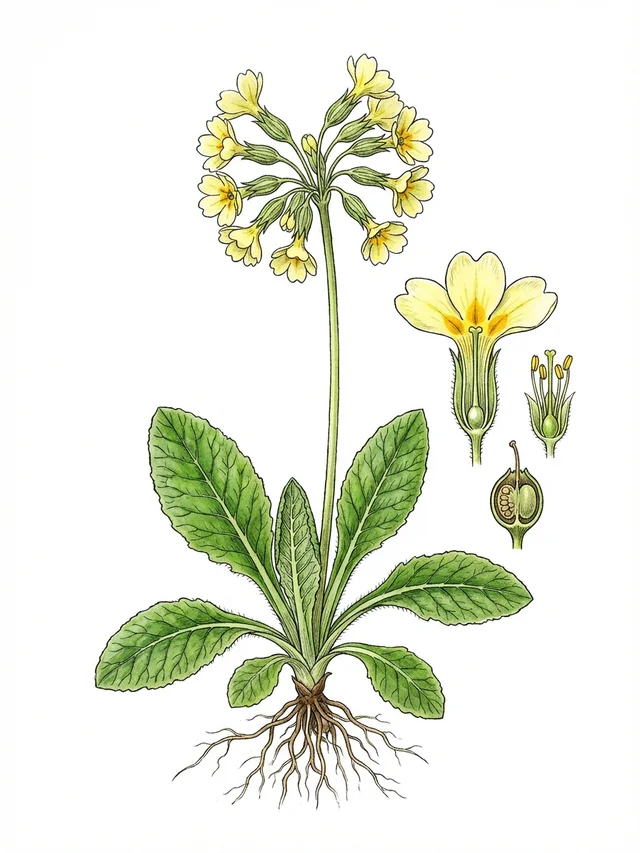
 Image to followAI-generated illustration
Trifolium campestre
Trifolium campestre
FamilyGenus: Trifoliumnative in Germany
🌿
92
Species
interact
🔗
458
Interactions
documented
About this species
An annual, low-growing herb of the pea family, native in Great Britain. It bears small, pale yellow flower heads from May to August and has trifoliate, broad leaflets. The plant thrives in sunny, moderately moist places with normal to nutrient-poor soil and is safe around children.
Ecological network
Click to highlight connections · Click again to open the species page
Loading network...
PollinationFlower visit
Ecological significance
No negative ecological impacts are associated with this native clover. It forms part of Britain's traditional grassland flora and is suited to sunny, low-disturbance, moderately moist sites on soils of normal to low fertility. It is not salt-tolerant.
Annual cycle
This annual species germinates in spring, grows through early summer and flowers from May to August. Seed ripens in late summer and the plant then dies back. New plants arise from seed the following year.
Safety note
Trifolium campestre is non-toxic and safe around children.
Standort & Merkmale
Light
Sonne
Moisture
Frisch (Mäßig feucht)
Soil
Mittelzehrer (Normaler Boden)
Flowering period
Mai – Aug
Soil reaction
Mäßig sauer bis neutral
Bioregion
Continental
Growth form
Krautige Pflanze
Woodiness
Nicht verholzt
Leaf type
Breitblättrig
Plant height
0.231 m
Morphological traits: TRY ID3 (CC BY 3.0) & TRY ID81 (CC BY)
Pflege & Anbau
If grown in a garden setting, provide a sunny position with normal, moderately moist soil. The species is adapted to low-nutrient conditions and needs little feeding. It is an annual and will complete its life cycle in one season; allow some plants to set seed if you wish them to return the following year.
Scientific profile
Trifolium campestre is an annual herbaceous plant in the pea family (Fabaceae), native in Great Britain. It is non-woody and broad-leaved, with a prostrate to ascending habit and typically reaches around 23 cm in height. The leaves are composed of three obovate, toothed leaflets. Dense, shortly ellipsoidal flower heads, about 1.2–1.3 cm across, appear from late spring; each tiny flower is 4–6 mm long and pale yellow. Flowering extends from May to August. The plant grows in full sun on moderately moist, normal soils and is also able to persist on nutrient-poor ground. It shows a preference for sites with little disturbance and cannot tolerate salt. Its seed mass averages 0.26 mg.
Pollinators & visitors
71 Arten interagieren mit dieser Pflanze
Thymelicus sylvestrisErynnis tagesLasioglossum lativentreCalameuta filiformisPieris brassicaeLasiommata megeraMelitta leporinaBoloria seleneColias croceusNomada fulvicornisOsmia aurulentaGonepteryx rhamniNomada flavaHalictus confususLeptidea sinapisBombus pascuorumBombus pratorumBombus magnusBombus hortorumAndrena wilkellaBombus muscorumElkalyce argiadesBombus lucorumBombus monticolaBombus lapidariusCoenonympha pamphilusPieris rapaeVanessa atalantaBombus vestalisHalictus tumulorumAndrena labialisBombus hypnorumAndrena clarkellaBombus sylvestrisHalictus rubicundusBombus sylvarumLasioglossum pauxillumAndrena flavipesLasioglossum glabriusculumAndrena ovatulaApis melliferaHalictus maculatusPolyommatus icarusMacropis fulvipesEucera pseudeucnemideaEucera digitataLasioglossum lineareOsmia scutellarisHalictus tetrazonianellusOsmia gallarum
Other flower visitors
21 other species visit the flowers
Capreolus capreolusHarpalus rufipesHarpalus griseusAmara ovataCantharis fuscaHarpalus distinguendusTrechus quadristriatusHemicrepidius hirtusAmara lunicollisAgriotes obscurusAmara plebejaHemicrepidius nigerHarpalus affinisDiachromus germanusHarpalus rubripesAnthicus antherinusPoecilus cupreusAmara convexiorAnisodactylus binotatusOedemera flavipesChetogena obliquata
Sources & data origin
•Interaktionsdaten via GloBI (CC-BY 4.0)
•pollinator_interactions
•FloraWeb / BfN
•EIVE 1.0 — Dengler et al. (2023), DOI: 10.3897/VCS.98324 (CC BY 4.0)
•GBIF Backbone Taxonomy — GBIF Secretariat (2024), DOI: 10.15468/39omei (CC BY 4.0)
•TRY Categorical Traits (ID3) — Kattge et al. (2012), DOI: 10.17871/TRY.3 (CC BY 3.0)
•TRY Global Spectrum (ID81) — Díaz et al. (2016/2021), DOI: 10.17871/TRY.81 (CC BY)
•Govaerts R et al. (2025) — World Checklist of Vascular Plants (WCVP) v14. Royal Botanic Gardens, Kew. DOI: 10.34885/xs7h-ze42 (CC BY 4.0)
All data is licensed under CC BY 4.0, CC0, or compatible terms. Attribution according to license conditions. Full source overview →