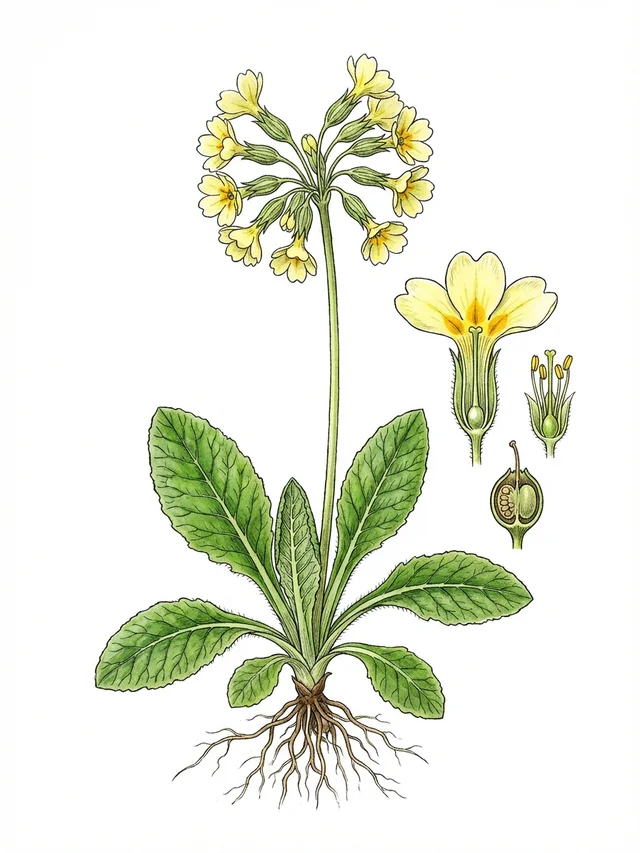
 Image to followAI-generated illustration
Trifolium dubium
Trifolium dubium
FamilyGenus: Trifoliumnative in Germany
🌿
79
Species
interact
🔗
130
Interactions
documented
About this species
A small, native annual clover with yellow flowers, common in grassy places throughout Great Britain.
Ecological network
Click to highlight connections · Click again to open the species page
Loading network...
PollinationFlower visit
Ecological significance
This native annual legume is a common component of many grassland communities. Its long flowering season extends from May to September, adding to the diversity of low-growing vegetation.
Annual cycle
Seeds germinate in spring and plants develop rapidly. Flowering begins in May and continues through to September. After setting seed, the annual plant dies back in autumn, completing its life cycle.
Safety note
The plant is not harmful to children.
Standort & Merkmale
Light
Halbschatten
Moisture
Frisch (Mäßig feucht)
Soil
Mittelzehrer (Normaler Boden)
Flowering period
Mai – Sep
Soil reaction
Mäßig sauer bis neutral
Bioregion
Continental
Growth form
Krautige Pflanze
Woodiness
Nicht verholzt
Leaf type
Breitblättrig
Plant height
0.208 m
Morphological traits: TRY ID3 (CC BY 3.0) & TRY ID81 (CC BY)
Pflege & Anbau
•
Light: partial shade suits it best.
•
Water: keep the soil moderately moist.
•
Soil: normal garden soil.
•
As an annual, it will complete its life cycle in one season. Allowing some flowers to set seed encourages self-sowing for the following year.
Scientific profile
Trifolium dubium is a low, annual herbaceous plant native to Great Britain. It has a prostrate or ascending growth form and typically reaches about 20 centimetres in height. The stems are slender and carry broad leaves divided into three oval leaflets. From May to September small heads of tiny yellow pea-flowers, each 3–3.5 millimetres long, are produced. This species grows in partial shade on moderately moist, normal soil. It is found in habitats with low disturbance and neutral to slightly acid conditions, and it does not tolerate salt. The plant is not threatened in the wild.
Pollinators & visitors
53 Arten interagieren mit dieser Pflanze
Pieris brassicaePolyommatus icarusDysstroma truncataCabera pusariaBombus pascuorumThymelicus sylvestrisLeptidea sinapisErynnis tagesLasiommata megeraGonepteryx rhamniColias croceusLasioglossum lativentreBombus vestalisHalictus confususNomada flavaBombus monticolaBombus lapidariusBombus pratorumAndrena labialisBombus lucorumBombus hypnorumBombus muscorumPieris rapaeSphecodes gibbusCoenonympha pamphilusOsmia aurulentaNomada fulvicornisVanessa atalantaMelitta leporinaHalictus tumulorumBombus hortorumBombus magnusOchropleura plectaApamea monoglyphaColostygia pectinatariaLasioglossum pauxillumNoctua comes HübnerNyea lurideolaPseudovadonia lividaSelenia dentariaApis melliferaAndrena haemorrhoaBombus terrestrisAndrena wilkellaLasioglossum villosulumEpistrophe grossulariaeEilema lurideolaEremobia ochroleucaEupithecia vulgataHydraecia micacea
Other flower visitors
26 other species visit the flowers
Anthicus antherinusFringilla coelebsColumba palumbusMeleagris gallopavoAmara communisHarpalus griseusAmara ovataCantharis fuscaAnisodactylus binotatusHarpalus distinguendusTrechus quadristriatusAmara lunicollisAgriotes obscurusColoeus monedulaAmara plebejaHemicrepidius nigerHarpalus affinisHarpalus rubripesAmara convexiorPoecilus cupreusHarpalus rufipesHemicrepidius hirtusCoccinella septempunctataProtapion nigritarseChloromyia formosaKorscheltellus lupulina
Sources & data origin
•Interaktionsdaten via GloBI (CC-BY 4.0)
•Cook et al. (2025) UK Butterfly & Moth Traits (DOI: 10.5285/dbc7cc17-cbbd-49dd-bab4-8e8855768d66)
•pollinator_interactions
•Baden-Böhm F, App M, Thiele J (2022) — The FloRes Database: A floral resources trait database for pollinator habitat-assessment generated by a multistep workflow. Johann Heinrich von Thünen-Institut, Dryad, DOI: 10.5061/dryad.djh9w0w29 (CC0)
•FloraWeb / BfN
•EIVE 1.0 — Dengler et al. (2023), DOI: 10.3897/VCS.98324 (CC BY 4.0)
•GBIF Backbone Taxonomy — GBIF Secretariat (2024), DOI: 10.15468/39omei (CC BY 4.0)
•TRY Categorical Traits (ID3) — Kattge et al. (2012), DOI: 10.17871/TRY.3 (CC BY 3.0)
•TRY Global Spectrum (ID81) — Díaz et al. (2016/2021), DOI: 10.17871/TRY.81 (CC BY)
•Govaerts R et al. (2025) — World Checklist of Vascular Plants (WCVP) v14. Royal Botanic Gardens, Kew. DOI: 10.34885/xs7h-ze42 (CC BY 4.0)
All data is licensed under CC BY 4.0, CC0, or compatible terms. Attribution according to license conditions. Full source overview →