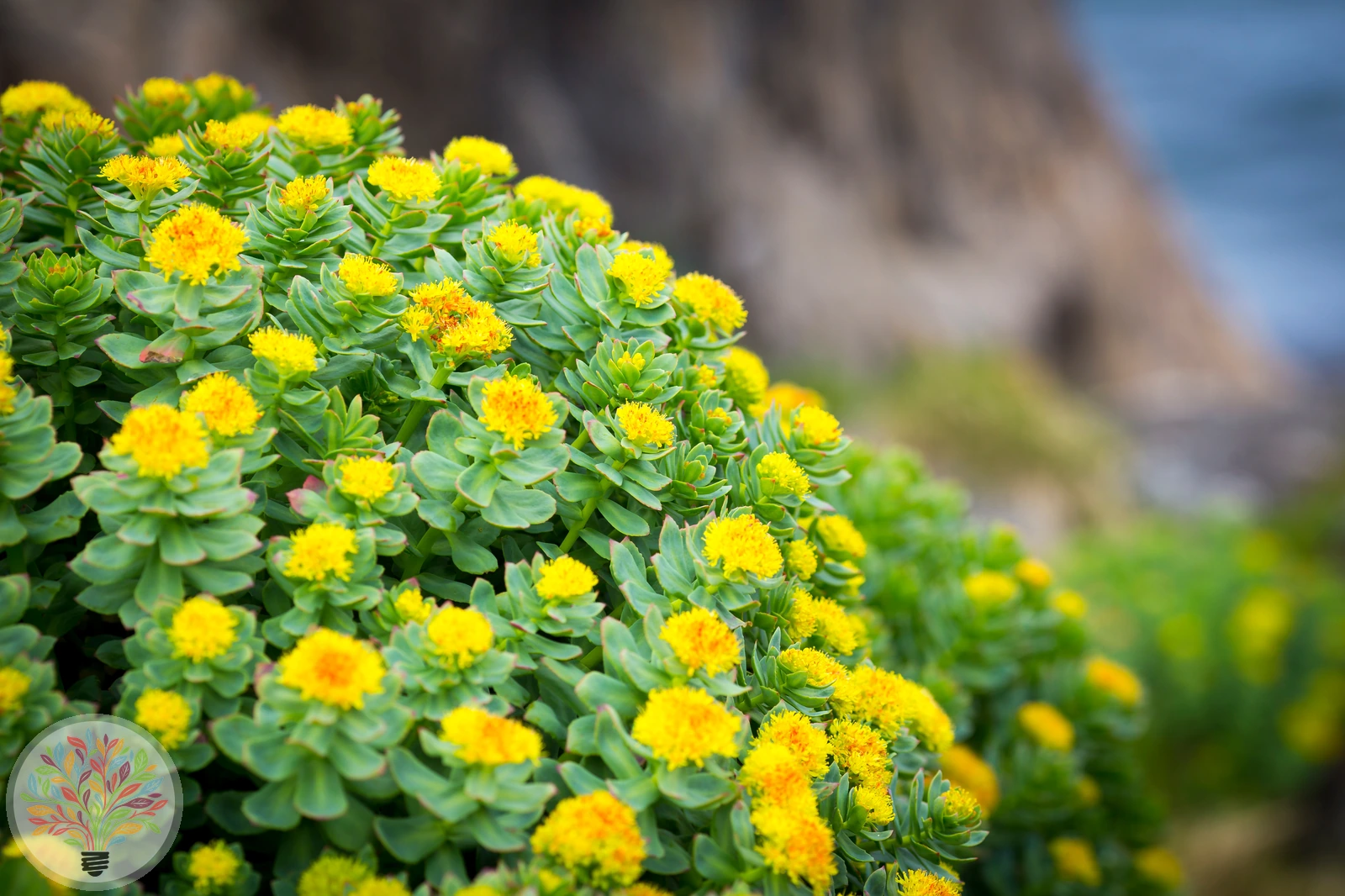
Rhodiola rosea
Rhodiola rosea
FamilyGenus: Rhodiolaheimisch in Deutschland
🌿
5
Species
interact
🔗
5
Interactions
documented
🐛
2
Host relationships
Species
About this species
Rhodiola rosea is a native succulent with broad, fleshy leaves and a low, non-woody growth form. It thrives in full sun on fresh, nutrient-poor soils and is associated with cold, alpine-type conditions. Flowering occurs between June and August. It is native in Great Britain.
Ecological network
Click to highlight connections · Click again to open species page
Netzwerk wird geladen...
PollinationLarval hostFlower visit
Ecological significance
As a native element of Britain's upland flora, Rhodiola rosea is adapted to nutrient-poor, rocky sites with low disturbance. It contributes to the biodiversity of these specialised habitats, particularly during its summer flowering period when it may attract pollinating insects.
Annual cycle
Flowering occurs from June to August.
Standort & Merkmale
Light
Sonne
Moisture
Frisch (Mäßig feucht)
Soil
Schwachzehrer (Magerer Boden)
Bloom time
Jun – Aug
Soil reaction
Mäßig sauer bis neutral
Bioregion
Continental
Growth form
Sukkulente
Woodiness
Nicht verholzt
Leaf type
Breitblättrig
Morphological traits: TRY ID3 (CC BY 3.0) & TRY ID81 (CC BY)
Pflege & Anbau
Provide a sunny position with very well-drained, gritty, low-fertility soil. Water moderately to keep the root zone fresh but never waterlogged. The plant is fully cold-hardy and suited to exposed sites. A rock garden or alpine trough that mimics its natural cold, open habitat is ideal.
Scientific profile
Rhodiola rosea is a native British plant belonging to the stonecrop family (Crassulaceae). It forms a low, non-woody succulent with broad, succulent leaves adapted to water storage. The species flowers between June and August. Ellenberg-type indicator values place it firmly in full sun (light value 7), on fresh to moderately moist soils (moisture value 6), and on nutrient-poor substrates (nutrient value 2). It shows a strong affinity for cold, alpine or northern climates (temperature value 3) and is associated with sites of low disturbance. In Britain it typically inhabits exposed rocky ledges and crevices in upland areas, where it integrates into natural, species-rich montane vegetation.
Bestäuber & Besucher
2 Arten interagieren mit dieser Pflanze
Scolitantides orionLarus canus
Other flower visitors
1 other species visit the flowers
Brassicogethes aeneus
Sources & data origin
•TraitCH — CC BY 4.0TraitCH 2.0 contributors; imported as source-preserving NaturKompass taxon evidence.
•TRY v6.0 / BiolFlor flowering phenology (Request 47350) — CC BY 4.0TRY request 47350 (Public, Data Released, TRY v6.0; 2026-02-15). Cite TRY: Kattge et al. (2020), doi:10.1111/gcb.14904; original source: Trefflich, A., Klotz, S. & Kühn, I. (2002). Blühphänologie. BIOLFLOR, Schriftenreihe für Vegetationskunde 38:127–131.
•Interaktionsdaten via GloBI (CC-BY 4.0)
•FloraWeb / BfN
•EIVE 1.0 — Dengler et al. (2023), DOI: 10.3897/VCS.98324 (CC BY 4.0)
•GBIF Backbone Taxonomy — GBIF Secretariat (2024), DOI: 10.15468/39omei (CC BY 4.0)
•TRY Categorical Traits (ID3) — Kattge et al. (2012), DOI: 10.17871/TRY.3 (CC BY 3.0)
•TRY Global Spectrum (ID81) — Díaz et al. (2016/2021), DOI: 10.17871/TRY.81 (CC BY)
•Govaerts R et al. (2025) — World Checklist of Vascular Plants (WCVP) v14. Royal Botanic Gardens, Kew. DOI: 10.34885/xs7h-ze42 (CC BY 4.0)
•Foto: © Adobe Stock / AdobeStock_394791534
All data is licensed under CC BY 4.0, CC0, or compatible. Attribution according to license terms. Full source overview →