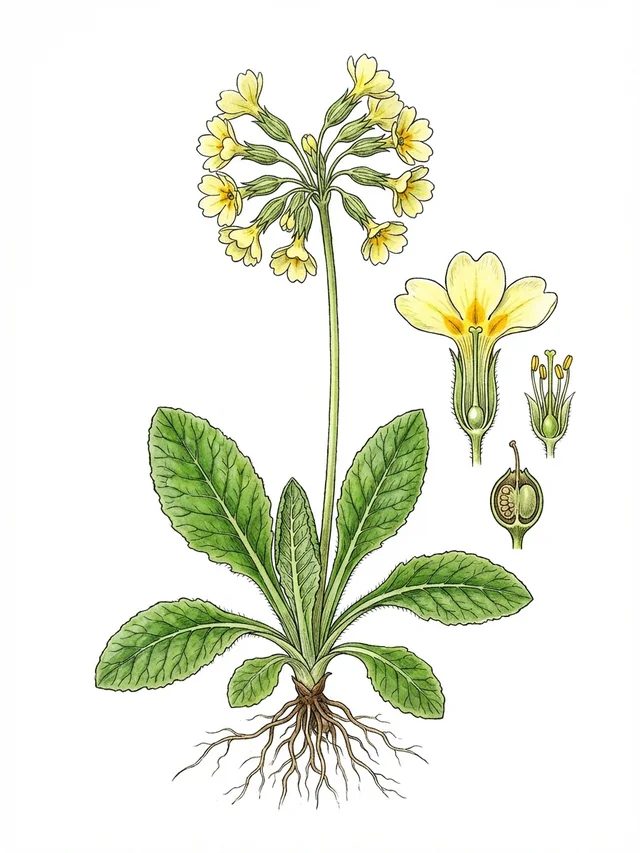
 Bild folgtKI-generierte Illustration
Veronica anagallis-aquatica
Veronica anagallis-aquatica
FamilyGenus: Veronicaheimisch in Deutschland
🌿
34
Species
interact
🔗
36
Interactions
documented
About this species
A native aquatic speedwell, Veronica anagallis-aquatica thrives in sunny, wet, nutrient-rich soils, producing upright stems of small flowers from May to October. It grows naturally in shallow water margins, marshes and stream banks across Great Britain.
Ecological network
Click to highlight connections · Click again to open species page
Netzwerk wird geladen...
Pollination
Ecological significance
As a native member of wetland vegetation, it contributes to the structure of marshes, ditches and stream banks, providing habitat for aquatic and semi-aquatic organisms.
Annual cycle
New growth emerges in spring. Upright flowering stems develop and bloom from May to October. Seeds mature and are shed from late summer onwards. Foliage dies back in late autumn.
Standort & Merkmale
Light
Sonne
Moisture
Feucht
Soil
Starkzehrer (Nährstoffreicher/Fetter Boden)
Bloom time
Mai – Okt
Soil reaction
Basisch / Kalkhold
Bioregion
Continental
Growth form
Krautige Pflanze
Woodiness
Nicht verholzt
Leaf type
Breitblättrig
Plant height
0.367 m
Morphological traits: TRY ID3 (CC BY 3.0) & TRY ID81 (CC BY)
Pflege & Anbau
Plant in full sun at the edge of a garden pond or in a bog garden, in permanently moist, fertile, preferably calcareous soil. Water during prolonged dry spells if not sited at the water’s edge. The plant self-seeds freely; remove dead stems in late winter before new growth appears.
Scientific profile
Veronica anagallis-aquatica is a herbaceous plant in the plantain family (Plantaginaceae), adapted to aquatic and semi-aquatic conditions. It bears broad, non-woody stems that reach about 37 cm in height and smooth, faintly toothed leaves with a leaf area of roughly 13 cm². The tiny flowers are carried in elongated racemes and open successively from May to October, yielding minuscule seeds (around 0.04 mg) that disperse by water. This species is native in Great Britain and occupies sunny, wet habitats such as ditch margins, slow-flowing streams, marshes and shallow water bodies. It prefers calcareous, nutrient-rich substrates, tolerates only low levels of disturbance and is not salt tolerant, reflecting a strong association with permanently moist, undisturbed environments.
Bestäuber & Besucher
34 Arten interagieren mit dieser Pflanze
Melitta leporinaNomada goodenianaNomada panzeriAndrena flavipesPieris rapaePyronia tithonusCelastrina argiolusSphecodes ephippiusLasiommata megeraMegachile willughbiellaOsmia bicornisBombus pascuorumAndrena minutulaLasioglossum zonulumAglais urticaeNomada flavoguttataNomada flavaPolygonia c-albumVanessa atalantaPieris brassicaeLasioglossum morioAndrena fucataHylaeus communisAndrena haemorrhoaAndrena bicolorAndrena wilkellaHalictus confususAndrena labiataLasioglossum calceatumAndrena subopacaAndrena nigroaeneaHalictus tumulorumAphantopus hyperantusPhymatodes testaceus
Sources & data origin
•TRY v6.0 / BiolFlor flowering phenology (Request 47350) — CC BY 4.0TRY request 47350 (Public, Data Released, TRY v6.0; 2026-02-15). Cite TRY: Kattge et al. (2020), doi:10.1111/gcb.14904; original source: Trefflich, A., Klotz, S. & Kühn, I. (2002). Blühphänologie. BIOLFLOR, Schriftenreihe für Vegetationskunde 38:127–131.
•Interaktionsdaten via GloBI (CC-BY 4.0)
•FloraWeb / BfN
•EIVE 1.0 — Dengler et al. (2023), DOI: 10.3897/VCS.98324 (CC BY 4.0)
•GBIF Backbone Taxonomy — GBIF Secretariat (2024), DOI: 10.15468/39omei (CC BY 4.0)
•TRY Categorical Traits (ID3) — Kattge et al. (2012), DOI: 10.17871/TRY.3 (CC BY 3.0)
•TRY Global Spectrum (ID81) — Díaz et al. (2016/2021), DOI: 10.17871/TRY.81 (CC BY)
•Govaerts R et al. (2025) — World Checklist of Vascular Plants (WCVP) v14. Royal Botanic Gardens, Kew. DOI: 10.34885/xs7h-ze42 (CC BY 4.0)
All data is licensed under CC BY 4.0, CC0, or compatible. Attribution according to license terms. Full source overview →