Main article
Megastigmus aculeatus in rose hips: when a wasp grows up inside a rose seed
Created with AI and translated(learn more)
This article was generated automatically based on the stated sources and translated into this language. The underlying video descriptions were editorially reviewed; this article itself was not individually reviewed by a subject-matter editor.
More about our AI transparencyRose hips can harbour a rose seed wasp inside. Find out how Megastigmus aculeatus lives and how to observe its life cycle in the garden.
In brief
A rose hip can look ripe and unremarkable from the outside – and still harbour a larva inside. In the rose seed wasp Megastigmus aculeatus, the larva does not develop in the red flesh, but in a single seed within a hard nutlet. The female wasp lays eggs in young, green rose hips in early summer. The larva eats the seed contents, overwinters protected in the seed and later emerges as a tiny adult wasp. Infestation is often impossible to see from the outside; even when the rose hip is opened, the nutlet itself must also be opened. Not every rose hip is infested, and frequency varies greatly with site, rose species, year and local population.
Introduction: A fruit that is more than food
If you pick a rose hip in late summer or autumn, you may think you are holding a simple fruit. Red, ripe, round or elongated depending on species. Yet beneath the surface, a second life can be taking place. A short garden video entitled 'This rose hip looks normal – but an animal lives inside' turns attention to the rose seed wasp Megastigmus aculeatus. It does not use the red flesh, but a single seed inside the rose hip. It is precisely there that its larva can develop.
Botanical background: What is a rose hip 'seed'?
Colloquially, you might refer to the hard pips in a rose hip as 'seeds'. Botanically, these hard structures are small nutlets. In technical language they are called achenes. They sit inside the fleshy rose hip. Each of these achenes contains one seed. For the rose, these seeds are the route to reproduction. For Megastigmus aculeatus, a single seed can become a complete development chamber.
The rose seed wasp Megastigmus aculeatus
Megastigmus aculeatus is a tiny wasp counted among the seed wasps. It is also called the rose seed wasp. It belongs to the family Torymidae. Seed wasps are insects whose larvae develop in plant seeds. The female has a long ovipositor. With it, she can lay eggs in young, still green rose hips. The ovipositor is not a tool for stinging humans; it serves to reach plant tissue.
Life cycle: From egg in early summer to emergence
The sequence is closely tied to the rose hip:
- Egg-laying: In early summer, the female pierces young, green rose hips with her ovipositor and lays eggs. The video description mentions a historical study on dog roses that gives June/July.
- Larva: After hatching, the larva does not sit freely among the nutlets. It develops inside a single seed. There it eats the seed contents.
- Overwintering: The larva can overwinter in the seed. While frost, rain and temperature fluctuations act outside, it remains protected in its plant chamber.
- Development and emergence: Later the larva develops further, pupates and finally a tiny adult wasp emerges.
For the wasp, a single nutlet fulfils several functions: egg-laying site, food source, nursery and winter quarters.
Why you often cannot see the infestation
From the outside, an infested rose hip often remains unremarkable. It can look red and ripe like any other. The reason: the larva sits in the seed, not in the flesh. Even if you open the rose hip, you first see the many nutlets. The larva remains hidden in a single nutlet. To find it, you would also have to open that nutlet. According to the video description, larvae and pupae were detected with the help of opened seeds and X-rays.
How common is infestation by the rose seed wasp?
The video description reports historical studies on wild roses showing that infestation need not be locally rare. Depending on the site studied, very different infestation rates were found. In individual studies, a considerable proportion of rose hips was affected. But this does not mean that every rose hip contains a larva. Frequency depends, among other things, on site, rose species, year and existing populations of the seed wasp. No reliable percentages are available.
What this means for the garden
Rose hips are a good example of how a plant structure can be differently important for different species. For the rose, the nutlets serve reproduction. For birds and other animals, rose hips are food. For Megastigmus aculeatus, a single seed is the entire development chamber. If you have wild roses in the garden, some of the rose hips can therefore fulfil more than one ecological function. Whether and how strongly this affects the population depends on many factors. No precise figures are available.
Matching products
Available at Gartenexpedition.de
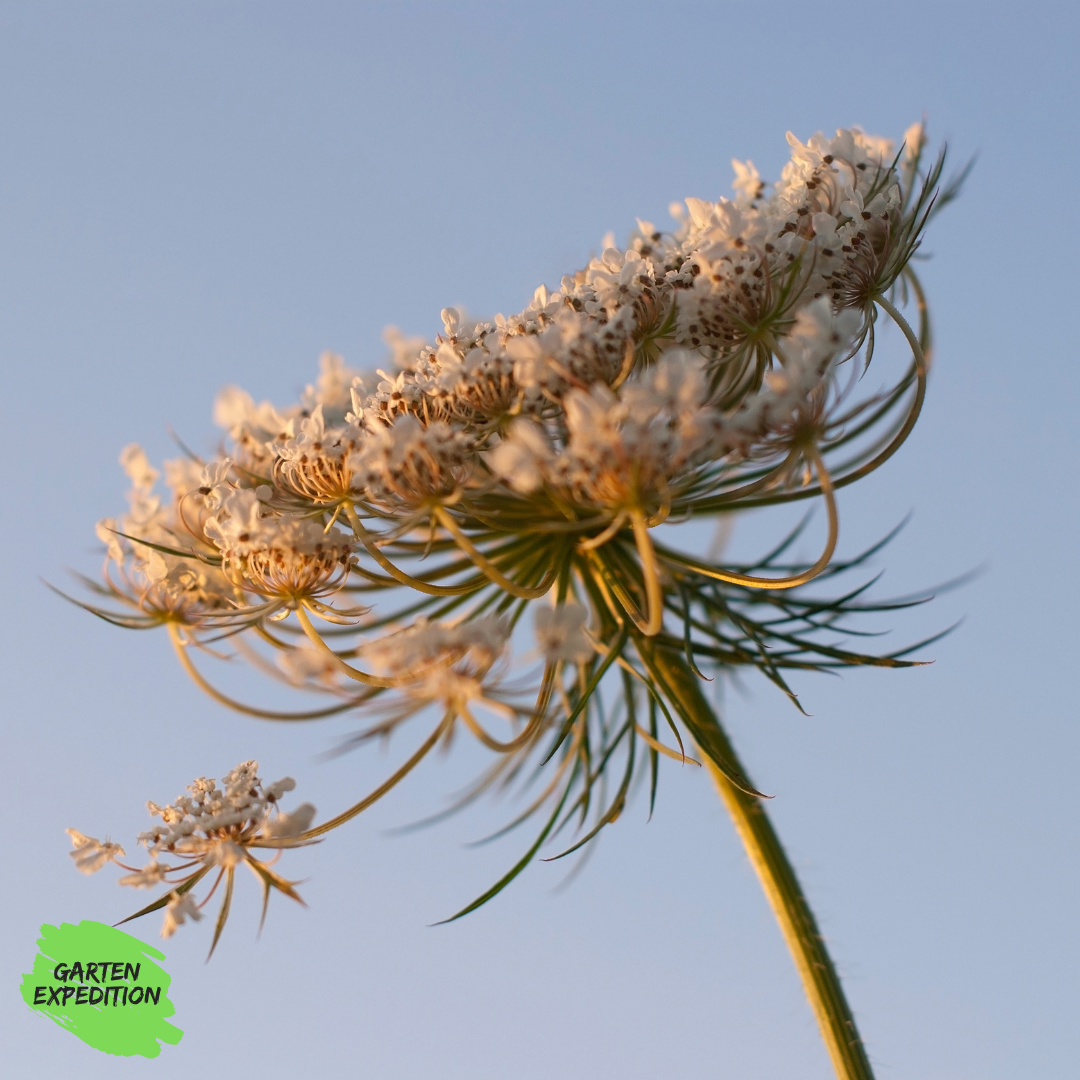
Wilde Möhre (Daucus carota)
2,50 €
incl. VAT, plus shipping costs
To shop →
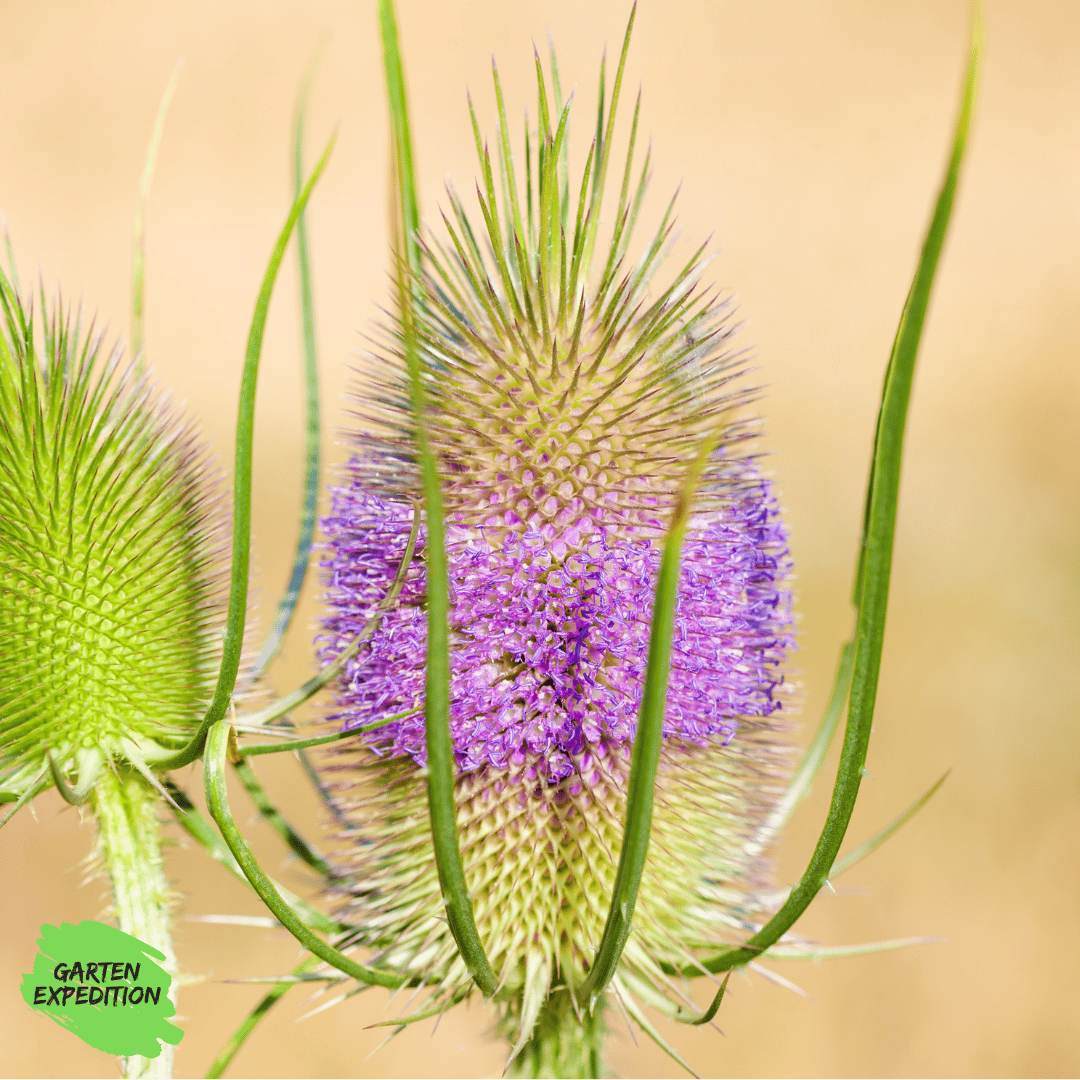
Wilde Karde (Dipsacus fullonum)
3,27 €
incl. VAT, plus shipping costs
To shop →
Partner note: The linked products are from Gartenexpedition.de. By purchasing, you support our work.
In practice: How to observe in the garden
- Leave wild roses standing. Wild roses (Rosa spp.), including the dog rose (Rosa canina), provide rose hips as food and as a development site. If you do not prune in autumn, the fruits remain over winter.
- Observe in late summer and autumn. At this time the rose hips are ripe and red. Not every fruit is infested. Look for roses that carry many fruits.
- Leave some of the rose hips on the plant until spring. In this way, larvae that overwinter in the seed can remain protected and develop later. This is the simplest and least disturbing method.
- If you want to know more, open individual rose hips that have already fallen or dried. Cut them open carefully and look at the nutlets with a magnifying glass. Open individual nutlets only when you are truly curious – because doing so can disturb or injure the larva. Better for nature observation is to leave the fruits on the plant and watch for emerging wasps.
- Document your observation. Note date, location, rose species (if known), number of rose hips examined and what you found. In this way you can compare over years.
- Harvest rose hips for tea or jam as usual. Removing the nutlets also removes the development site.
Comparison table: One structure, several roles
| Level | What you perceive | Botanical classification | Importance for Megastigmus aculeatus |
|---|---|---|---|
| Rose hip | red, ripe fruit | fleshy outer part surrounding the nutlets | encloses and protects the nutlets |
| Nutlet | hard 'pips' | achene | contains one seed; one may be infested |
| Seed | usually invisible | reproductive unit of the rose | food, development chamber and winter quarters of the larva |
| Season | late summer/autumn | ripening time of the rose hips | egg-laying as early as early summer; larva overwinters in the seed |
Limits of observation and frequently asked questions
I opened a rose hip and found nothing. Is it definitely free?
Not necessarily. The larva sits in a single seed. If you open only the rose hip but not the nutlets, you can overlook it. Early larval stages are also very small. Examinations with a magnifying glass or, in studies, X-rays are more reliable.
Does the wasp harm the rose?
The larva eats the contents of one seed. That seed is lost to reproduction. This is a loss for the rose, but not automatically the death of the shrub. Precise effects on growth or population are not quantified.
Can I still harvest infested rose hips?
Yes, you can use rose hips for tea or jam. When you remove the nutlets, you also remove the development site.
Is Megastigmus aculeatus protected or invasive?
No reliable statement can be made on this.
How can I identify the species reliably?
Reliable identification of the tiny wasp requires specialist knowledge and usually a magnifying glass or a binocular microscope. The video description names the species but provides no identification characteristics. For garden observations, it is often easier to follow the life cycle on the rose hip than to identify the adult wasp reliably.
Sources and further information
- YouTube description for the video 'This rose hip looks normal – but an animal lives inside' – a source for this article. It mentions: studies on Megastigmus aculeatus on European wild roses; a historical study on the biology of dog roses; specialist literature on the family Torymidae and on seed wasps. The full bibliographic details of the mentioned studies are not given in the description.
- The shop, newsletter and social media pages linked in the video were not used as scientific evidence.
Keywords
All species data comes from scientific sources (CC BY 4.0 / CC0). Attribution according to licence terms. Complete source overview →
Last updated: 10/09/2026. Corrections can be reported via the feedback form.