Main article
Heat stress in the nature garden: Why drought encourages adaptation
Learn why heat stress in the nature garden is a natural process and how native plants like chicory survive heat through deep root growth.
Key points at a glance
- Established native wildflowers have strategies for coping with stress, such as deep root growth.
- Open, bare soil heats up significantly and loses moisture; dense vegetation, on the other hand, provides insulation.
- Wilting leaves in the afternoon are often a temporary protective response to reduce transpiration, not an immediate sign of the plant dying.
- Targeted watering is only necessary for young plants and freshly planted perennials, not for established populations.
Matching videos on the topic
Top 5 Wildpflanzen im Juni: Diese Arten machen deine Wiese wertvoller- Gartenexpedition #naturgarten
Naturgarten-Logistik: Schneckenschutz, Wasserpflanzen & Substrat-Optimierung
Why heat in the garden is a biological stress test
Temperatures often rise significantly in June. While many gardeners instinctively reach for the watering can when they see plants wilting, it is important to understand the biological context. Heat and drought act as physiological stressors. However, for wildflowers adapted to the region, such as the ox-eye chamomile (Anthemis tinctoria) or the common chicory (Cichorium intybus), these trigger adaptation mechanisms rather than signifying immediate plant death.
An ecologically stable nature garden acts as its own microclimate. Plants with high leaf volume and deep root systems buffer soil temperatures. When we interfere with this process through constant watering or by leaving soil areas open and unmulched, we prevent robust structures from developing. A garden that relies on permanent external irrigation is significantly more vulnerable during high temperatures than a system that retains soil moisture through structural diversity.
Vegetation strategies during heat
Native wildflowers use various strategies to minimise the physiological effects of heat. Reducing evaporation by closing the stomata in their leaves often causes the plant to appear wilted in the midday sun, yet it fully recovers once darkness falls and temperatures drop.
| Strategy | Function | Ecological advantage |
|---|---|---|
| Deep roots | Accessing deeper layers | Stability during prolonged drought |
| Leaf mass | Shading the soil | Reduction of soil evaporation |
| Stomata closure | Lowering water loss | Protection against premature drying out |
| Deadwood/mulch | Insulation of the soil surface | Preservation of moisture and soil life |
Matching products
Available at Gartenexpedition.de
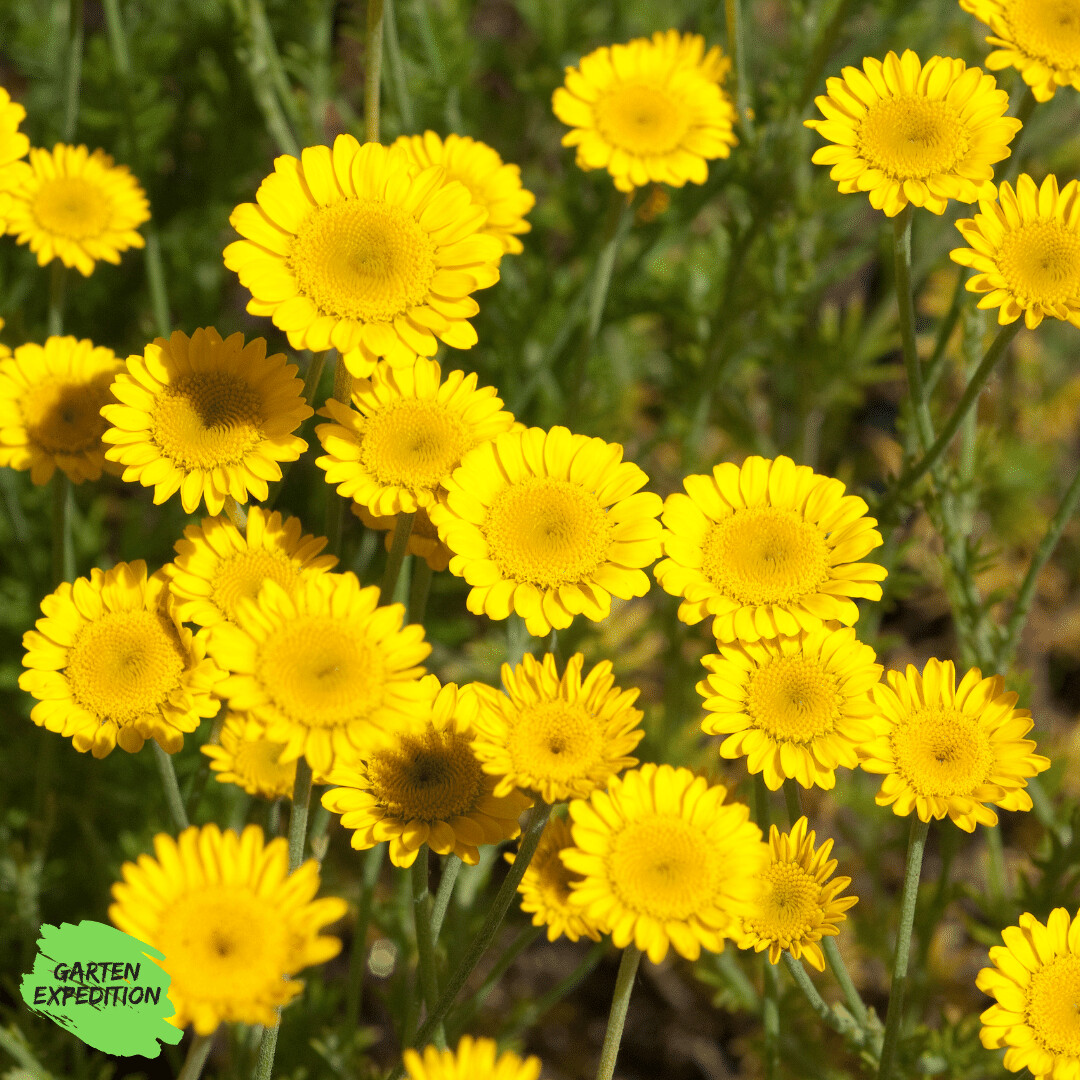
Färberkamille (Anthemis tinctoria)
2,00 €
incl. VAT, plus shipping costs
To shop →

Wegwarte (Cichorium intybus)
2,00 €
incl. VAT, plus shipping costs
To shop →
Partner note: The linked products are from Gartenexpedition.de. By purchasing, you support our work.
How to respond correctly in the nature garden
- Observe instead of acting: Check the next morning to see if the plant has recovered. If it is firm again in the morning, the wilting during the day was merely a protective response.
- Maximise soil cover: Avoid bare soil. Use mulch or plant ground cover to protect the soil surface from direct sunlight.
- Targeted watering: Only spend time on freshly planted specimens or container plants. Established perennials in the open ground do not need support if planted in the correct location.
- Maintain structure: Do not mow your wildflower meadow completely down. The tall vegetation acts as an insulating layer for soil-dwelling creatures and keeps the root zone cooler.
- Encourage root growth: Accept slight dry spells for established plants. This forces the roots to penetrate deeper into the soil to access water reserves, making the plant more resilient in the long term.
A nature-orientated garden that relies on deadwood, a structure-rich meadow and a dense plant cover is much better equipped against climatic extremes than a closely-mown lawn, as it retains soil moisture and actively buffers soil temperatures.
Frequently asked questions
Do I need to water my wildflower meadow daily in the heat?
No. Established wildflowers do not require artificial irrigation during heat. They are adapted to drought and use their deep roots to self-sustain.
Why are my plants drooping at midday?
This is a protective response. The plant closes its stomata to reduce transpiration. It usually recovers when temperatures drop at night.
label_deepening_articles
- Wild bees in the heat: How to support brood and foraging
- Creating a gravel garden: Establishing drought-resistant habitats
- Mulching the nature garden: Effective soil management in June
- Adapting the nature garden: Why thinning out makes ecological sense
- Mycorrhiza in the garden: Help during drought and heat
More articles on this topic
In-depth
Adapting Your Wildlife Garden: Why Thinning Out Makes Ecological Sense
Learn why accepting drought stress in your garden is a valuable ecological adaptation and how to build a resilient wildlife garden.
In-depthMycorrhiza in the garden: Help during drought and heat
Find out how mycorrhizal fungi improve your plants' water supply and actively support your garden during drought and heat stress in June.
In-depthWild bees in hot weather: How to support brood and foraging
Learn how heat affects the brood behaviour of wild bees and which measures you can take to protect nesting sites and food sources during dry spells.
In-depthMulching your wildlife garden: Effective soil management in June
Learn how to retain soil moisture in your wildlife garden during June through correct mulching and how to sustainably promote the vitality of your soil.
In-depthCreating a gravel garden: Building drought-resistant habitats
Learn how to create a nature-friendly gravel garden as a habitat for wild bees. No membrane, using native perennials for a stable microclimate.
All species data comes from scientific sources (CC BY 4.0 / CC0). Attribution according to licence terms. Complete source overview →