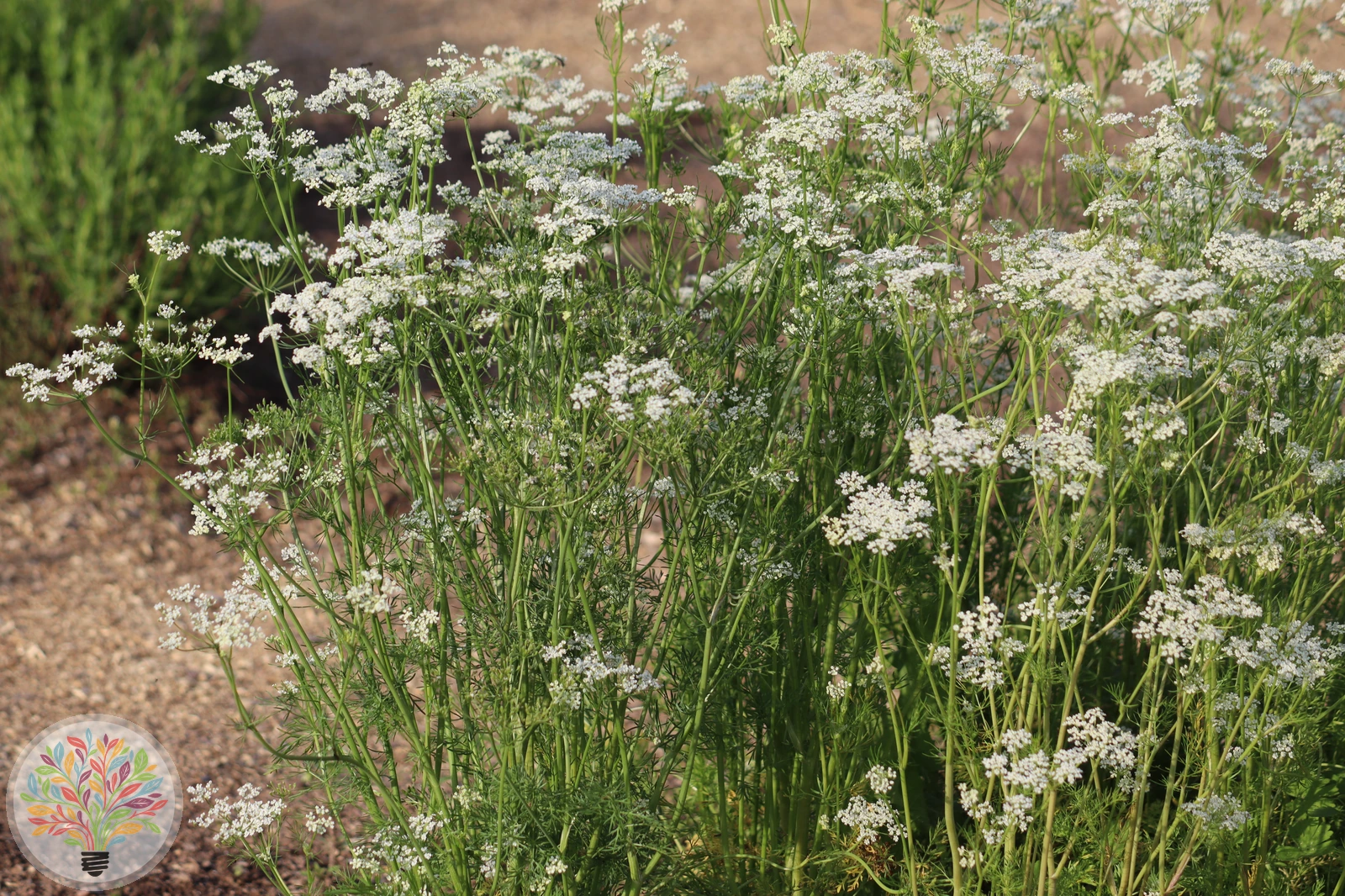
Carum carvi
Carum carvi
FamilyGenus: Carumnative in Germany
🌿
87
Species
interact
🔗
112
Interactions
documented
🐛
1
Host relationships
Species
About this species
An archaeophyte herbaceous plant of the carrot family, Carum carvi is well known as caraway, with aromatic seeds used in cooking. It bears delicate umbels of white to pinkish flowers from late spring through early autumn and flourishes in sunny, moderately moist conditions.
Ecological network
Click to highlight connections · Click again to open the species page
Loading network...
PollinationLarval hostFlower visit
Ecological significance
As a long-established archaeophyte, Carum carvi is a stable component of the flora and shows no tendency to become invasive. It contributes to local plant diversity without documented negative effects.
Annual cycle
Flowering occurs between April and September.
Safety note
The species is considered safe for children, with no known toxicity.
Standort & Merkmale
Light
Sonne
Moisture
Frisch (Mäßig feucht)
Soil
Mittelzehrer (Normaler Boden)
Flowering period
Apr – Sep
Soil reaction
Mäßig sauer bis neutral
Bioregion
Continental
Growth form
Krautige Pflanze
Woodiness
Nicht verholzt
Leaf type
Breitblättrig
Plant height
0.438 m
Morphological traits: TRY ID3 (CC BY 3.0) & TRY ID81 (CC BY)
Pflege & Anbau
•
Sun: Full sun.
•
Moisture: Moderately moist, well-drained soil.
•
Soil: Average garden soil, neutral to slightly acid.
•
Maintenance: Low; tolerates some disturbance.
•
Propagation: Typically grown from seed.
Scientific profile
Carum carvi is a herbaceous, non-woody plant with broad leaves, typically reaching about 0.44 metres in height. Its tiny flowers are held in compound umbels and appear from April through to September. The plant is an archaeophyte in Great Britain, established since ancient times. It favours sunny locations with moderately moist, neutral to slightly acid soils of average fertility. It tolerates low levels of disturbance and has a slight tolerance of salinity. Indicator values place it among plants of moderately warm climates.
Pollinators & visitors
48 Arten interagieren mit dieser Pflanze
Papilio machaonLasioglossum pauxillumManiola jurtinaLasioglossum malachurumCephus pygmeusAndrena subopacaAndrena minutuloidesAnastrangalia sanguinolentaAndrena proximaFormica rufibarbisPseudovadonia lividaDinoptera collarisBombus humilisTiphia femorataLasioglossum laticepsBombus sylvarumStenurella melanuraAthalia rosaeNeocrepidodera ferrugineaAthous subfuscusAlosterna tabacicolorTenthredo nothaEctemnius lapidariusArge ochropusBombus soroeensisApis melliferaAndrena chrysoscelesBombus pascuorumBombus lapidariusLasioglossum laevigatumRutpela maculataPolyommatus coridonScaeva seleniticaSphaerophoria scriptaCheilosia urbanaScaeva pyrastriMelangyna compositarumSphaerophoria interruptaAndrena alfkenellaMelanostoma mellinumSyritta pipiensEristalis arbustorumMerodon funestusCheilosia impressaEupeodes corollaeBombus ssEristalis tenaxChrysotoxum bicinctum
Other flower visitors
38 other species visit the flowers
Oedemera femorataOedemera podagrariaeMalachius bipustulatusRhagonycha fulvaDasytes plumbeusPhyllopertha horticolaHemicrepidius nigerCantharis fuscaLasius nigerMyrmica rubraoedemera luridaAnaspis frontalisMyrmica ruginodisAmara communisHarpalus griseusAmara ovataTrechus quadristriatusOphonus azureusAgriotes obscurusHemicrepidius hirtusAnthicus antherinusDiachromus germanusOphonus ardosiacusHarpalus latusHarpalus rufipesAmara familiarisAmara convexiorAnthrenus verbasciAmara lunicollisAmara plebejaHydrophoria diabataThricops cunctansIchnomonidae sp.7Pipiziella viduataThricops nigrifronsMorellia aenescensThricops longipesTenthredo arcuata
Sources & data origin
•Cook et al. (2025) UK Butterfly & Moth Traits (DOI: 10.5285/dbc7cc17-cbbd-49dd-bab4-8e8855768d66)
•Interaktionsdaten via GloBI (CC-BY 4.0)
•pollinator_interactions
•FloraWeb / BfN
•EIVE 1.0 — Dengler et al. (2023), DOI: 10.3897/VCS.98324 (CC BY 4.0)
•GBIF Backbone Taxonomy — GBIF Secretariat (2024), DOI: 10.15468/39omei (CC BY 4.0)
•TRY Categorical Traits (ID3) — Kattge et al. (2012), DOI: 10.17871/TRY.3 (CC BY 3.0)
•TRY Global Spectrum (ID81) — Díaz et al. (2016/2021), DOI: 10.17871/TRY.81 (CC BY)
•Govaerts R et al. (2025) — World Checklist of Vascular Plants (WCVP) v14. Royal Botanic Gardens, Kew. DOI: 10.34885/xs7h-ze42 (CC BY 4.0)
•Foto: © Adobe Stock / AdobeStock_1525556131
All data is licensed under CC BY 4.0, CC0, or compatible terms. Attribution according to license conditions. Full source overview →