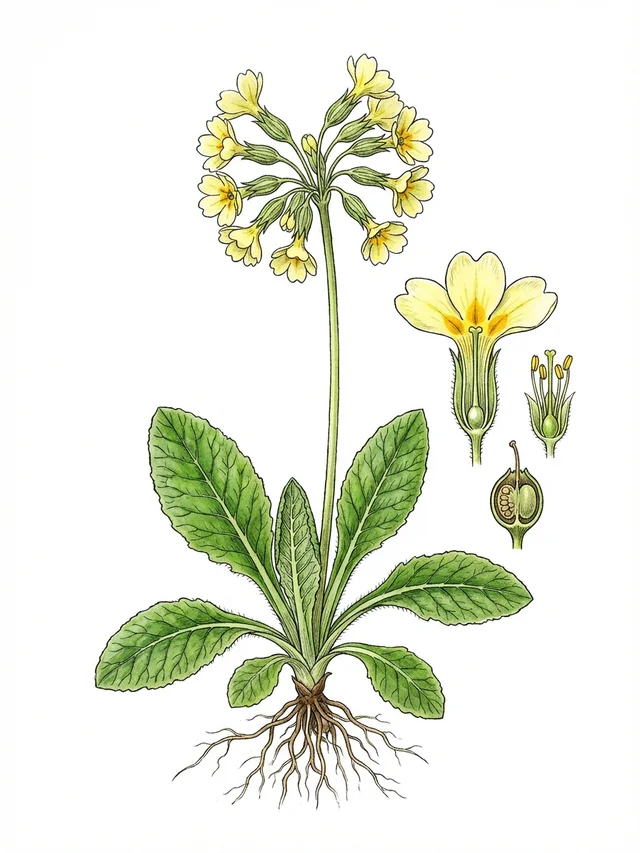
 Image to followAI-generated illustration
Isatis tinctoria
Isatis tinctoria
FamilyGenus: Waidnative in Germany
🌿
17
Species
interact
🔗
20
Interactions
documented
🐛
1
Host relationships
Species
About this species
A herbaceous, broad-leaved plant of dry, calcareous grasslands, Isatis tinctoria is an established archaeophyte in Great Britain. Its bright yellow flowers appear from May to July and it reaches about 0.7 metres in height. It thrives in full sun on poor, lime-rich soils.
Ecological network
Click to highlight connections · Click again to open the species page
Loading network...
PollinationLarval hostFlower visit
Ecological significance
A long-established archaeophyte of dry calcareous grasslands and nutrient-poor meadows. It contributes to the diversity of these habitats but no specific wildlife associations are documented in the available evidence.
Annual cycle
Flowering occurs from May through July. Foliage is herbaceous and dies back in autumn; new growth resumes in spring.
Standort & Merkmale
Light
Sonne
Moisture
Trocken
Soil
Schwachzehrer (Magerer Boden)
Flowering period
Mai – Jul
Soil reaction
Basisch / Kalkhold
Bioregion
Continental
Growth form
Krautige Pflanze
Woodiness
Nicht verholzt
Leaf type
Breitblättrig
Plant height
0.691 m
Morphological traits: TRY ID3 (CC BY 3.0) & TRY ID81 (CC BY)
Pflege & Anbau
Grow in full sun and a freely draining, lime-rich, low-nutrient soil. Once established, the plant tolerates dry conditions and requires little supplemental feeding. Flowering stems reach about 0.7 metres; cut back after flowering if self-seeding is unwanted.
Scientific profile
Isatis tinctoria is a non-woody, terrestrial herb that typically grows to around 0.69 metres tall. Its broad leaves have an average area of 1380 square millimetres, and the plant forms arbuscular mycorrhizal associations. The flowers, which are produced from May to July, are yellow and are borne on erect stems. It occurs most often in dry, base-rich habitats – principally calcareous grasslands and, secondarily, nutrient-poor extensive meadows. The species is adapted to full sun, very well-drained and nutrient-poor conditions, and it tolerates soils with a high calcium content. In Great Britain it is classed as an archaeophyte, having become established before 1500, while its natural range spans Europe, south-western and south-eastern Europe, northern Africa and temperate Asia. Individual seeds (diaspores) average 1.97 milligrams in mass.
Pollinators & visitors
10 Arten interagieren mit dieser Pflanze
Other flower visitors
6 other species visit the flowers
Sources & data origin
•Interaktionsdaten via GloBI (CC-BY 4.0)
•FloraWeb / BfN
•EIVE 1.0 — Dengler et al. (2023), DOI: 10.3897/VCS.98324 (CC BY 4.0)
•GBIF Backbone Taxonomy — GBIF Secretariat (2024), DOI: 10.15468/39omei (CC BY 4.0)
•TRY Categorical Traits (ID3) — Kattge et al. (2012), DOI: 10.17871/TRY.3 (CC BY 3.0)
•TRY Global Spectrum (ID81) — Díaz et al. (2016/2021), DOI: 10.17871/TRY.81 (CC BY)
•Checklist Alien Plants Belgium — Verloove F (2023), Botanic Garden Meise (CC BY 4.0)
•Govaerts R et al. (2025) — World Checklist of Vascular Plants (WCVP) v14. Royal Botanic Gardens, Kew. DOI: 10.34885/xs7h-ze42 (CC BY 4.0)
All data is licensed under CC BY 4.0, CC0, or compatible terms. Attribution according to license conditions. Full source overview →