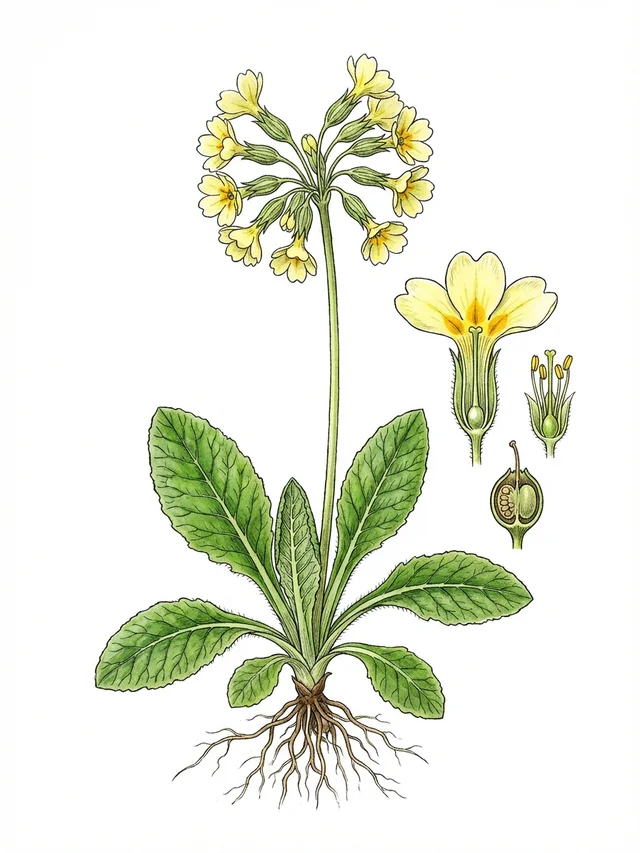
 Image to followAI-generated illustration
Pyrus communis
Pyrus communis
FamilyGenus: Pyrusnative in Germany
🌿
106
Species
interact
🔗
153
Interactions
documented
🐛
30
Host relationships
Species
About this species
A deciduous broad-leaved tree, long established in Britain as an archaeophyte. It blooms in April and May and prefers partial shade with moderately moist soil.
Ecological network
Click to highlight connections · Click again to open the species page
Loading network...
PollinationLarval hostFlower visit
Ecological significance
An established archaeophyte pear tree, Pyrus communis has been naturalised for centuries and is cultivated for its edible fruit.
Annual cycle
Flowers in April and May. Deciduous leaves are shed in autumn, with new foliage emerging in spring.
Standort & Merkmale
Light
Halbschatten
Moisture
Frisch (Mäßig feucht)
Soil
—
Flowering period
Apr – Mai
Bioregion
Continental
Growth form
Baum
Woodiness
Verholzt
Leaf type
Breitblättrig
Leaf phenology
Laubabwerfend
Plant height
18.464 m
Morphological traits: TRY ID3 (CC BY 3.0) & TRY ID81 (CC BY)
Pflege & Anbau
•
Light: Partial shade.
•
Soil: Moderately moist, well-drained.
•
Position: Sheltered spot with minimal disturbance.
Scientific profile
Pyrus communis is a deciduous, broad-leaved tree in the rose family (Rosaceae), reaching about 18.5 m. It prefers partial shade and moderately moist soil, flowering in April and May. It is associated with low-disturbance habitats and moderately warm temperatures. In Great Britain it is an archaeophyte, present since prehistoric times.
Pollinators & visitors
36 Arten interagieren mit dieser Pflanze
Turdus merulaAndrena fulvaOsmia bicornisAndrena cinerariaBombus hypnorumAndrena gravidaAndrena carantonicaBombus pratorumBombus terrestrisNomada flavaAndrena dorsataAndrena minutulaBombus lapidariusApis melliferaVanessa atalantaPararge aegeriaAndrena chrysoscelesOperophtera brumataAndrena flavipesAporia crataegiNymphalis antiopaVespa velutina nigrithoraxBombus pascuorumVespa crabroOsmia cornutaNymphalis polychlorosAndrena nitidaNomada lathburianaAndrena haemorrhoaNomada fabricianaBombus hortorumBombus lucorum/terrestrisXylocopa violaceaAndrena rufulaLasioglossum laevigatumBombus gr. terrestris
Host relationships
30 species use this plant as a host
Cossus cossusCilix glaucataGastropacha quercifoliaPasiphila rectangulataOurapteryx sambucariaLycia hirtariaStauropus fagiEuproctis similisAcronicta psiNola cucullatellaDiloba caeruleocephalaNaenia typicaCosmia pyralinaZeuzera pyrinaEupithecia exiguataAcronicta tridensEuproctis chrysorrhoeaPlodia interpunctellaAglia tauXestia c-nigrumEupsilia transversaCosmia trapezinaAllophyes oxyacanthaeOrgyia antiquaLymantria disparEctropis crepusculariaColotois pennariaCaliroa cerasiYponomeuta padellaBiston betularia
Other flower visitors
40 other species visit the flowers
Garrulus glandariusChloris chlorisTurdus pilarisSylvia borinSturnus vulgarisSylvia communisPhylloscopus collybitaSylvia atricapillaColumba palumbusPyrrhula pyrrhulaTroglodytes troglodytesRegulus ignicapillaAcridotheres tristisPasser domesticusPsittacula krameriOrsodacne cerasiXyleborus disparPogonocherus hispidusPhyllobius pyriHippodamia variegataCoccinella septempunctatalasius brunneusHarmonia axyridisCetonia aurataStreptopelia orientalisPoecile palustrisErithacus rubeculaTurdus philomelosSylvia currucaCyanistes caeruleusTurdus viscivorusTurdus iliacusPica picaFringilla coelebsPhoenicurus phoenicurusFringilla montifringillaParus majorPasser montanusPhoenicurus ochrurosMuscicapa striata
Sources & data origin
•Cook et al. (2025) UK Butterfly & Moth Traits (DOI: 10.5285/dbc7cc17-cbbd-49dd-bab4-8e8855768d66)
•Interaktionsdaten via GloBI (CC-BY 4.0)
•pollinator_interactions
•Baden-Böhm F, App M, Thiele J (2022) — The FloRes Database: A floral resources trait database for pollinator habitat-assessment generated by a multistep workflow. Johann Heinrich von Thünen-Institut, Dryad, DOI: 10.5061/dryad.djh9w0w29 (CC0)
•FloraWeb / BfN
•EIVE 1.0 — Dengler et al. (2023), DOI: 10.3897/VCS.98324 (CC BY 4.0)
•GBIF Backbone Taxonomy — GBIF Secretariat (2024), DOI: 10.15468/39omei (CC BY 4.0)
•TRY Categorical Traits (ID3) — Kattge et al. (2012), DOI: 10.17871/TRY.3 (CC BY 3.0)
•TRY Global Spectrum (ID81) — Díaz et al. (2016/2021), DOI: 10.17871/TRY.81 (CC BY)
•Checklist Alien Plants Belgium — Verloove F (2023), Botanic Garden Meise (CC BY 4.0)
•Govaerts R et al. (2025) — World Checklist of Vascular Plants (WCVP) v14. Royal Botanic Gardens, Kew. DOI: 10.34885/xs7h-ze42 (CC BY 4.0)
All data is licensed under CC BY 4.0, CC0, or compatible terms. Attribution according to license conditions. Full source overview →